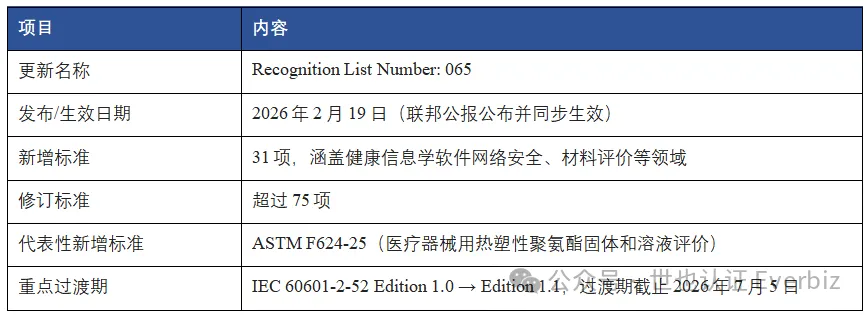
On 19 February 2026, the US Food and Drug Administration (FDA) published in the Federal Register the latest revision of its list of FDA Recognized Consensus Standards, “Recognition List Number: 065” (List 065).
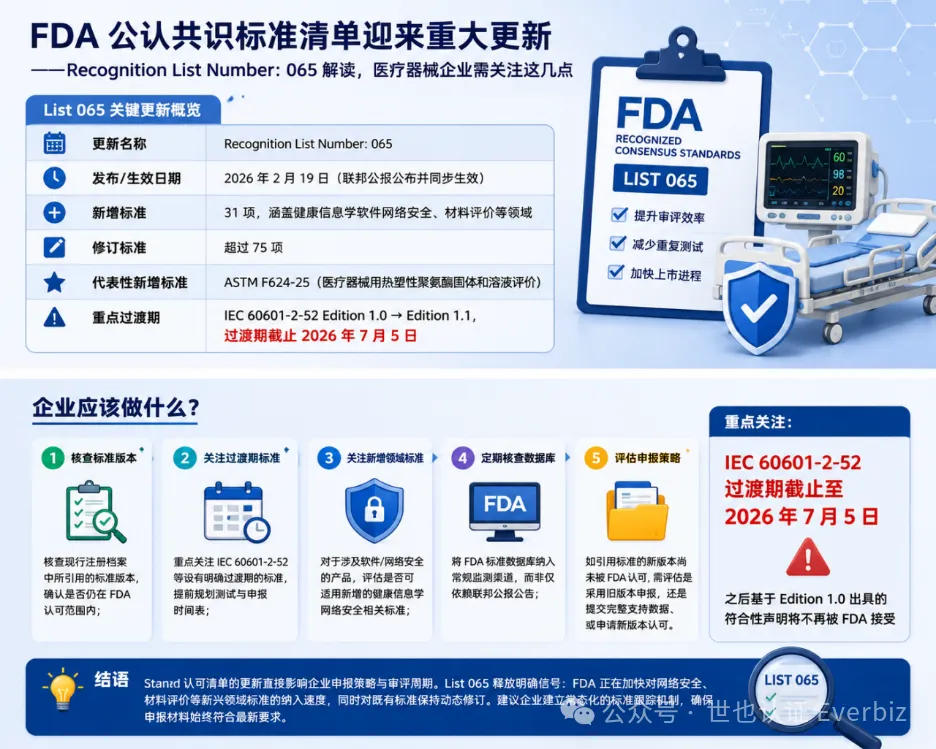
The update took effect on publication, adding 31 standards and revising more than 75, an important adjustment to the standards used in premarket review of medical devices. For companies planning to submit a 510(k), De Novo or PMA to the US market, changes to the list directly affect whether the FDA will accept their Declarations of Conformity (DOC).
Recognized consensus standards are voluntary technical standards developed by standards development organizations (such as ISO, IEC, ASTM and AAMI) through open consultation and consensus. They are not legally binding unless explicitly incorporated by federal regulation. The legal basis for the FDA’s standards recognition program is Section 514(c)(1)(B) of the Federal Food, Drug, and Cosmetic Act.
Once a standard is formally recognized by the FDA and placed on the list, companies can submit a Declaration of Conformity to that standard in premarket submissions, avoiding the need to submit raw test data for independent evaluation by reviewers and significantly improving review efficiency.
2. What Has List 065 Updated?
1. 31 new standards, with cybersecurity a highlight
Several of the newly recognized standards relate to health informatics software with a focus on cybersecurity considerations, reflecting the FDA’s continued shift toward cybersecurity risk management in the regulation of medical device software.
The new standards also include ASTM F624-25 for evaluating thermoplastic polyurethane solids and solutions used in medical devices, directly relevant to manufacturers of catheters, implants and other devices using these materials.
2. More than 75 standards revised
In addition to new standards, List 065 revises more than 75 recognized standards, including version updates, corrections to the extent of recognition and clarifications of Supplementary Information Sheets. Companies should check one by one whether the standards cited for their products are within the scope of the revisions.
3. Key focus: the IEC 60601-2-52 transition period
IEC 60601-2-52 (medical beds) Edition 1.0 has been superseded by Edition 1.1, with a transition period ending on 5 July 2026. After 5 July 2026, Declarations of Conformity based on Edition 1.0 will no longer be accepted by the FDA.
Companies with affected products should complete testing to the new edition as soon as possible, or submit based on the old edition before the transition period ends, to avoid registration delays caused by the version change.
3. Database vs. Federal Register: Which Prevails?
It is worth emphasizing that the FDA also maintains a publicly searchable online database, “Recognized Consensus Standards: Medical Devices”. This database – not how widely a standard is accepted in the industry – is the authoritative source for determining whether a standard has been formally recognized by the FDA.
More importantly, after making a recognition decision, the FDA usually updates the online database before the formal Federal Register notice is published. This means companies that wait only for Federal Register notices may miss first-hand information on changes in recognition status. We recommend that compliance teams include regular checks of the online database in their routine regulatory monitoring.
4. What Should Companies Do?
-
Check the versions of standards cited in current registration files and confirm they are still within the FDA’s recognition;
-
Pay particular attention to standards with explicit transition periods such as IEC 60601-2-52, and plan testing and submission timelines in advance;
-
For software/cybersecurity products, assess whether the newly recognized health informatics cybersecurity standards apply;
-
Include the FDA standards database in routine monitoring rather than relying only on Federal Register notices;
-
If a new version of a cited standard has not yet been recognized by the FDA, assess whether to submit based on the old version, submit complete supporting data, or request recognition of the new version.
5. Conclusion
Although updates to the recognized standards list may look like technical administrative adjustments, they directly affect companies’ submission strategies and review timelines. The signal from List 065 is clear: the FDA is accelerating the inclusion of standards in emerging areas such as cybersecurity and material evaluation, while continuously revising existing standards. We recommend that medical device companies establish a routine standards-tracking mechanism and promptly reflect the latest recognition status in their technical documentation and quality systems, to ensure submissions always meet the latest requirements.
EVERBIZ reminds medical device companies going global: include the FDA recognized consensus standards database in your routine regulatory monitoring, and at the project start and document finalization stages of a 510(k), De Novo or PMA, always check the versions and extent of recognition of the standards cited, to avoid additional information requests and review delays caused by superseded versions.
If you need to check the standards applicable to your product or assess your submission strategy, contact EVERBIZ for professional compliance support.
EVERBIZ Certification Services (Shanghai) Co., Ltd. (EVERBIZ) is a professional compliance service platform for testing, certification, consulting and training of medical products, dedicated to helping leading medical R&D companies at home and abroad improve their compliance capabilities and competitiveness. The company has offices and branches in Shanghai (China), Hong Kong, Munich (Germany), Salzburg (Austria), Thailand, Vietnam, Singapore and Malaysia, covering nearly 25 industries of compliance products (such as medical devices, new energy, household appliances, lighting, tools, laboratory instruments, machinery, in vitro diagnostics, wireless products and reagents).
Shanghai: Room 909, Building 1, Lane 111 Luxiang Road, Baoshan District, Shanghai, China
Germany: Landsberger Str. 155, 80687 München, Germany
Austria: Innsbrucker Bundesstraße 136/3, 5020 Salzburg, Austria
Hong Kong: Room A1, 11/F Winner Building, 36 Man Yue Street, Hung Hom, Kowloon, Hong Kong
Thailand: 5/32 Baan Klang Muang Monaco, Soi Anamai, Srinakarin Rd., Pattanakarn, Suan Luang, Bangkok 10250, Thailand
Singapore: 133 New Bridge Road #8-1 Chinatown Point, Singapore 059413
Vietnam: 81 Cuxa Phu Lam D, Phuong Binh Phu, District 6, Ho Chi Minh City, Vietnam
Malaysia: Unit No. 92a, Jalan 13/142, Taman Orkid Desa, 56000 Kuala Lumpur, W.P. Kuala Lumpur, Malaysia

How Medical Device Exports to the EU Can Fail Because of the Carton
Shanghai’s Third-Party Medical Device Warehouses: An Analysis of 58 Licensed Companies
TGA Follows the EU MDR Extension: Australia’s New Transition Timeline for Medical Devices
Condom Registration in Thailand: A Medical Device Category with Its Own Legislation
Global Regulatory Convergence Accelerates: An In-Depth Look at the IMDRF Regulatory Reliance Playbook