– From an ordinary baby product to a vital-signs monitoring device: one extra function can mean a completely different compliance pathway
We recently came across a very representative project. The client previously made mainly toys and simple home products, and is now developing a baby bassinet/crib for the US market.
The “crib” itself is not an unfamiliar product; what makes the project complex is the series of smart functions the company wants to add.
The product is planned to sense the baby’s temperature by infrared, identify crying and abnormal states through audio capture, and even monitor heart rate and breathing, including detecting breathing interruptions. It will also have environmental sensing, sleep sensing, a display, speaker, lighting, a desktop alert device, a mobile app, and cloud data storage with sleep report analysis. Multiple sensors are also meant to detect the baby leaving the crib or falling.
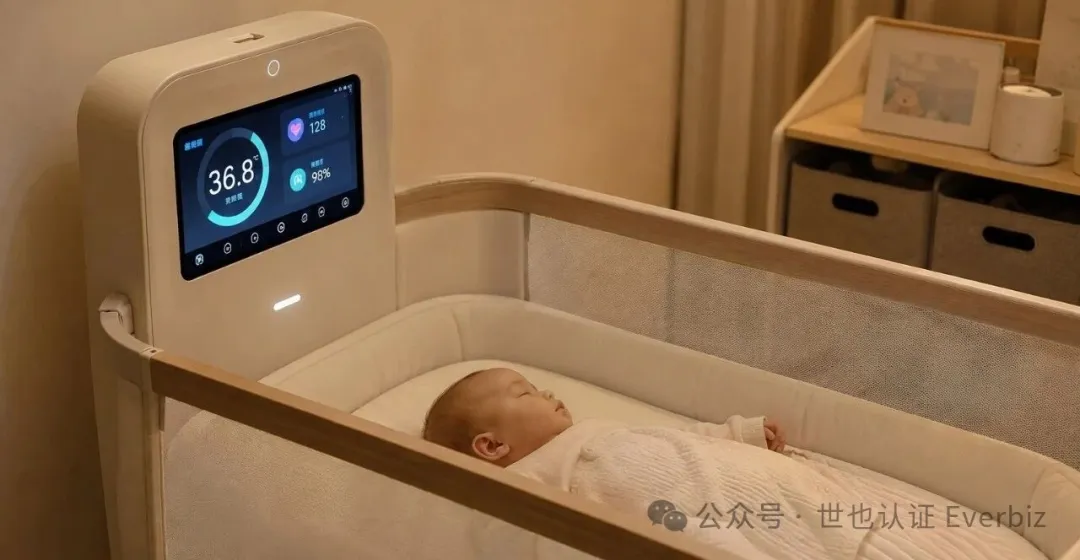
From a product manager’s perspective, this is an imaginative “multi-dimensional sensing system”; but from a regulatory engineer’s perspective, the question changes immediately: is it still a crib, or has it crossed into medical device territory?
Many companies entering the US for the first time habitually ask: “What certifications does this product need?” But for a product spanning children’s products, electrical and electronic equipment, wireless communications, software and health monitoring,
the more accurate question is: at the product definition stage, what intended use do we want it to have, what claims will we make, what data will it output, and what alerts will it give users?
Regulatory classification looks not only at what the hardware looks like but also at intended use, claims, labeling, algorithm outputs and actual use scenarios. Especially once a product starts measuring heart rate, breathing and temperature and alerting parents based on thresholds, the regulatory risk from the US FDA for such infant vital-signs monitors rises significantly.
In 2025 the FDA even issued a safety communication warning against using unauthorized devices intended to monitor infants’ vital signs.
2. Layer One: It Is First of All an Infant Sleep Product
If the final product meets the definition of a bassinet/cradle, the core US CPSC regulatory pathway usually falls under 16 CFR Part 1218, which references ASTM F2194.
Note in particular that from 21 February 2026, the CPSC adopted ASTM F2194-25 as the basis of the new mandatory version; products manufactured after 30 June 2026 must fully comply with the new mandatory requirements.
If the product does not fall into an existing category such as crib, bassinet or bedside sleeper but is marketed for sleep of infants under 5 months, 16 CFR Part 1236 (Infant Sleep Products) may also need to be assessed. So whether “we call it a crib or a cradle internally” does not determine the regulation – structure, use and marketing are what matter.
Also, a CPC is not some kind of “US toy certification”.
CPC stands for:
Children’s Product Certificate. For children’s products subject to mandatory CPSC rules, the manufacturer or importer must issue a CPC based on test results from a CPSC-accepted third-party laboratory.
For a bassinet/cradle, the CPC usually needs to cite at least 16 CFR Part 1218, together with other applicable rules on lead, phthalates, surface coatings, small parts, etc. depending on materials and structure.
3. Layer Two: Adding Electrical, Wireless and App Functions Widens the Compliance Scope
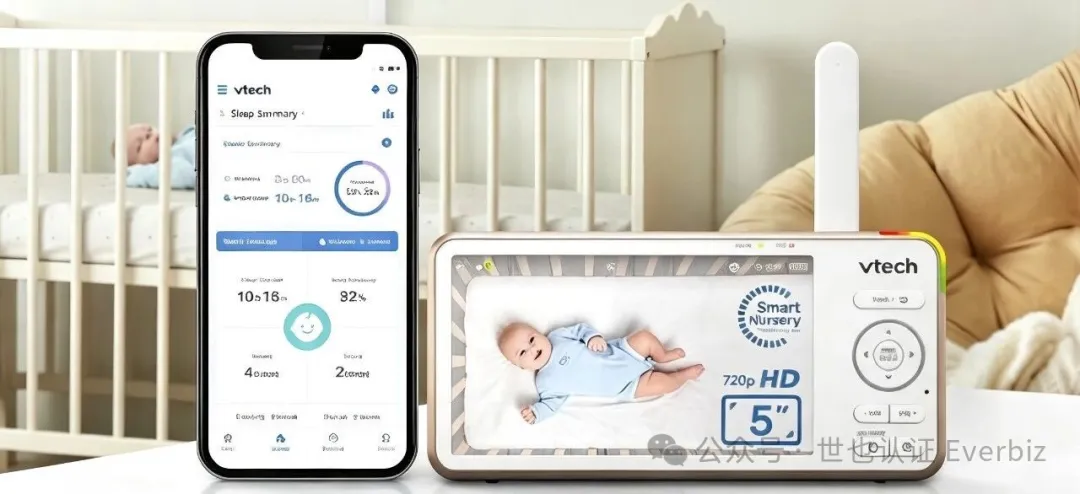
Once the product has a power supply, display, sensors, buzzer, Wi-Fi/Bluetooth or similar modules, you can’t look only at the mechanical safety of children’s products. Entering the US also requires assessing electrical safety, fire and shock risks, and FCC radio-frequency compliance.
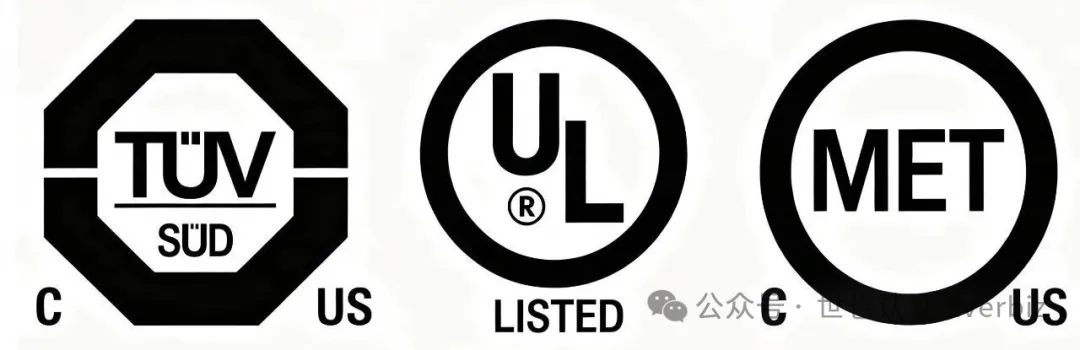
In the US occupational safety system this usually involves an NRTL (Nationally Recognized Testing Laboratory). Whether a particular NRTL listing is required must be judged based on sales channels, end-use installation, the local AHJ, customer procurement specifications and the specific product category; you cannot simply assume that all consumer products are legally required to have UL certification.
If the product contains intentional radiators such as Wi-Fi or Bluetooth, equipment authorization under the relevant FCC Part 15 provisions is usually required; even with a certified wireless module, the module integration conditions, antenna, labeling and requirements for the final product must still be checked.
4. The Real Watershed: When “Smart Sensing” Becomes “Medical Monitoring”
What’s most worth discussing in this case is not the number of functions, but that these functions may change the product’s regulatory status. For example:
Simply displaying room temperature is not the same as “measuring the baby’s temperature to determine whether it has a fever”;
Simply detecting “whether there is sound” carries different risks from “identifying abnormal crying and judging that the baby is unwell”;
Recording sleep duration is at a completely different regulatory level from “monitoring apnea, bradycardia or abnormal heart rate and raising alarms”;
Giving parents entertainment-style sleep trends is fundamentally different from outputting health reports that may influence care or medical decisions.
The FDA has made clear that products intended to monitor infants’ vital signs – such as heart/pulse rate, blood oxygen, respiratory rate and temperature – and alert caregivers must consider FDA marketing authorization requirements, and cannot simply rely on the general wellness policy to avoid medical device regulation. For a specific project, whether the outcome is 510(k), De Novo, another pathway, or avoiding the medical device scope by redefining the intended use, product classification and predicate/regulatory pathway analysis must be completed before design freeze.
5. If You Enter the Medical Device Pathway, There Is More Than Just IEC 60601
Another common misconception is that once you hear “medical electrical equipment”, doing IEC 60601-1 is enough. In fact, for a home-use, connected system with algorithms and alarms, standards are likely to come as a group.
The following is not a final list of applicable items but those worth screening first based on the current description:
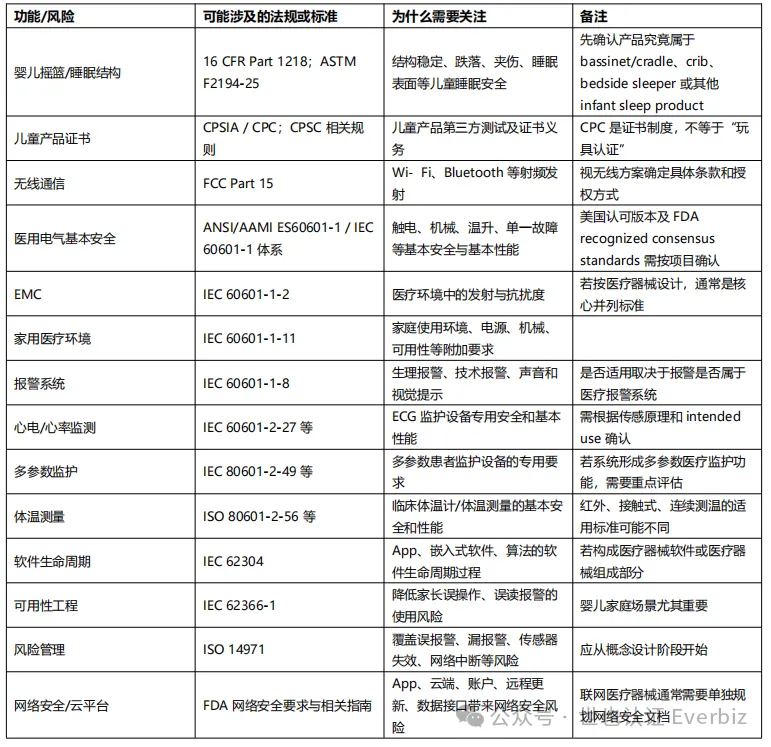
Note: the table above is for case discussion and early regulatory screening, not a final certification list for any specific product. The applicable regulations, FDA product codes, classification, standard versions and tests must be confirmed based on the product’s structure, sensing principles, intended use, alarm logic, user population and marketing copy.
6. Why I Believe Such Projects Must Bring Regulatory Staff into Early R&D
If a company develops the whole product first and only then goes to a lab to “get certified”, several typical problems are likely: the hardware architecture is fixed, only to find that creepage distances, power supply, sensor isolation or alarm design don’t meet requirements; the algorithm is finished, only to find that the original marketing claims have pushed the product into a higher-risk medical device pathway; the app and cloud platform are live, only to find that software life cycle, cybersecurity, data integrity and risk management records were never established; the molds are made, only to find that structural requirements for infant sleep products require changes.
These problems cannot be solved by “adding a report”. The later they are discovered, the higher the cost of rework. In serious cases, product functions must be cut, hardware redesigned, software revalidated and clinical/performance evidence prepared again, delaying the entire launch.
7. Truly High-End Products Compete on More Than the Number of Functions
We fully support Chinese companies in making more complex, higher-value products. Companies that used to make toys and home goods can absolutely move into smart health or even medical fields. But a company’s capabilities cannot be upgraded only in the R&D department.
When a product moves from “rocks, lights up and connects to the internet” to “senses a baby’s vital signs and makes judgments”, the company faces not just BOM, structure, algorithms and app experience, but an entire system of product classification, risk management, medical electrical safety, software life cycle, usability, clinical/performance evidence, cybersecurity, market registration and post-market responsibility.
So my advice for such projects has always been clear: innovate boldly on functions, but plan the regulatory pathway in advance.
Regulation is not something a lab “adds on” as the final step after the product is finished. For products that really want to enter high-end markets, compliance is itself part of product design.