Many medical device companies preparing to enter the six ASEAN markets (Singapore, Malaysia, Thailand, Indonesia, Vietnam and the Philippines) first hear the term “CSDT” at the submission stage. It appears in almost every ASEAN member state’s technical documentation guidance, yet few people explain its background clearly. This article covers the CSDT in full – from its legal status and internal structure to practical pitfalls.
1. What Is the CSDT and Where Does It Come From?
CSDT stands for the ASEAN Common Submission Dossier Template, a technical documentation format developed by the Medical Device Product Working Group of the ASEAN Consultative Committee for Standards and Quality (ACCSQ MDPWG). The first version was published in October 2010.
In 2014, the CSDT was formally incorporated into the text of the ASEAN Medical Device Directive (AMDD) as its Annex 4. The AMDD was signed by the economic ministers of the ten ASEAN countries in Bangkok, Thailand on 21 November 2014 and took effect from 1 January 2015 for member states that had ratified it.
Notably, the CSDT is not a format invented from scratch by ASEAN – it is essentially a regional “localized version” of the IMDRF (International Medical Device Regulators Forum) STED (Summary Technical Documentation). If a company has already prepared its technical documentation in STED format, converting it to CSDT requires much less work, which underpins many companies’ “prepare once, reuse in many countries” strategy.
2. What Problem Does the CSDT Solve?
Before the CSDT, each ASEAN member state had different format requirements for medical device technical documentation. To enter several ASEAN markets, companies had to re-format essentially the same evidence according to each country’s template – time-consuming, laborious and error-prone.
The CSDT provides a common table of contents for this “substantially identical evidence”, allowing companies to use the same technical content for submissions in several ASEAN markets and reducing duplicated work.

3. The Seven-Section Structure of the CSDT
A CSDT dossier usually contains the following seven sections, plus an appendix with the Essential Principles conformity checklist:
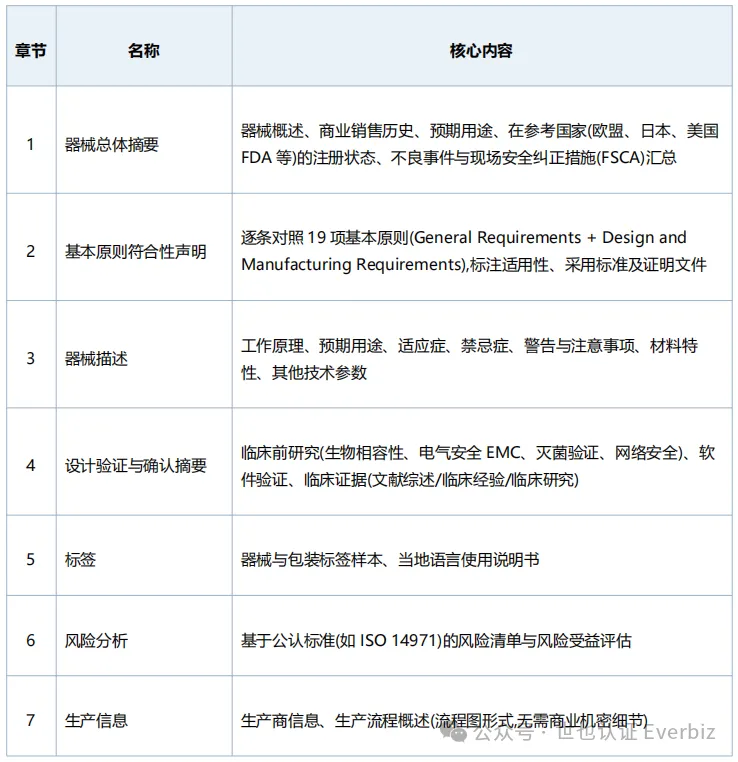
The level of detail required depends on the device’s risk class (Class A/B/C/D) and complexity – the higher the risk, the more detailed the requirements. If a section does not apply, the reason must be explained in writing rather than silently omitted.
4. Three Common Misunderstandings
1. Does the CSDT mean “unified ASEAN submission”?
No. The CSDT only standardizes the “table of contents” of the dossier; it does not create a centralized ASEAN application portal or unified approval. Manufacturers must still apply separately according to each national regulator’s requirements – approval by Singapore’s HSA does not mean that Malaysia’s MDA or the Thai FDA will automatically accept the product.
2. Can one CSDT dossier be used unchanged in all ASEAN countries?
No. The CSDT creates a reusable technical core, but every submission must be checked against current national regulations – requirements for reference-market evidence, declarations of conformity, certificates, labeling and letters of authorization may differ by country, and local agent rules, fees, language requirements and administrative documents are set by each country.
3. Does the CSDT apply to IVD products?
The AMDD framework allows regulators to use the CSDT for IVDs or to specify other submission formats; refer to each national regulator’s guidance (for example, Singapore’s HSA has published separate guidance for general medical devices and IVDs).
5. Which Countries Use the CSDT?
The six main ASEAN medical device markets – Singapore, Malaysia, Thailand, Indonesia, Vietnam and the Philippines – all use the CSDT as the basic format for technical documentation. Singapore, Malaysia and Indonesia have progressed faster in adopting the AMDD; Thailand, the Philippines and Cambodia have partly amended national regulations to align with CSDT requirements; Laos and Myanmar are still establishing the relevant regulations.
Taking Vietnam as an example, Ministry of Health Decision No. 2426/QĐ-BYT of 2021 directly turned the CSDT template into the official format for registration of Class B, C and D medical devices – section numbering and content requirements correspond almost one-to-one with the ASEAN original, making it a good reference for understanding “how the CSDT becomes national regulation”.
6. Practical Advice for Companies Going Global
-
Organize your technical documentation according to the common CSDT/STED structure as your internal “master file”, then add country-specific supplements as needed, rather than starting from scratch every time.
-
Pay particular attention to Section 2 (Essential Principles conformity checklist) and Section 6 (risk analysis) – these are the parts most often rejected because a template was “copied without genuinely arguing each item”.
-
Check the target country’s local requirements early: language (e.g. Vietnamese IFUs), local authorized representative/registrant qualifications, fees and review timelines – none of these are covered by the CSDT itself.
-
For IVD products, check whether the target country has published separate IVD technical documentation guidance, and don’t simply apply the section order of the general-device CSDT.
7. Summary
EVERBIZ International Medical Device Registration: specializing in global medical device regulations and international registration services
From product classification, regulatory analysis and ISO 13485 system planning to overseas registration, technical documentation and local regulatory compliance, we help Chinese medical device companies enter global markets more efficiently.
If your product is entering Southeast Asia, contact us for medical device registration and ISO 13485 compliance advice for Singapore, Malaysia, Thailand, Indonesia, the Philippines, Vietnam and other markets.