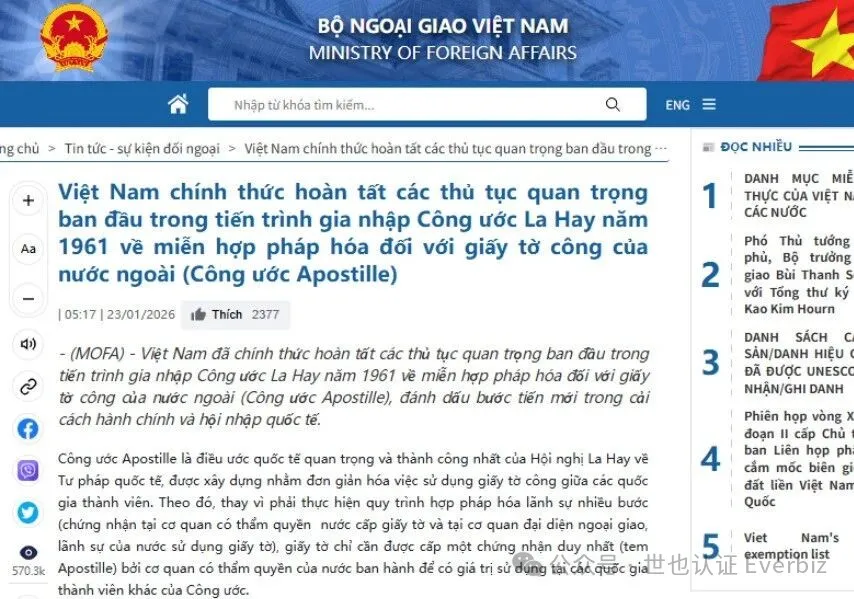
On 11 September 2026, the Convention Abolishing the Requirement of Legalisation for Foreign Public Documents (the “Hague Apostille Convention”) enters into force for Vietnam, making Vietnam the 129th contracting party. For Chinese companies pursuing medical device registration and market access in Vietnam, this is not just diplomatic news but a compliance speed-up that directly affects “how soon company documents can be used”.
On 31 December 2025, Vietnam deposited its instrument of accession with the depositary, the Ministry of Foreign Affairs of the Netherlands, formally starting the accession process.
On 25 February 2026, Deputy Prime Minister Bui Thanh Son signed Decision No. 330/QĐ-TTg approving the national plan to implement the Apostille Convention, designating the Ministry of Foreign Affairs as the coordinating authority and the Ministry of Public Security as responsible for document authenticity verification and anti-counterfeiting, with electronic apostilles (e-Apostille) to be introduced gradually.
On 23 July 2026, the Vietnamese government issued a decree giving specific guidance on the authority, procedures and scope of documents for apostilles, covering judicial documents, administrative documents (civil status, nationality, criminal records, diplomas, health certificates, etc.), notarial deeds and certification documents.
On 11 September 2026, the Convention enters into force for Vietnam, and public documents exchanged between Vietnam and the other 128 contracting parties will gradually move away from traditional double consular legalization.
2. Chinese Companies Are Not New to the Apostille
Notably, China itself is a party to the Apostille Convention – it acceded on 8 March 2023 and the Convention entered into force for China on 7 November 2023. In other words, when Chinese companies send documents for use in Vietnam, they follow a mature process that has been running in China for nearly three years:
-
Step 1: have the document notarized by a domestic notary office;
-
Step 2: submit the notarized document to China’s Ministry of Foreign Affairs or an authorized local foreign affairs office to apply for an apostille certificate;
-
Step 3: the apostille is attached to the document as a silver national-emblem seal sticker and can be verified online via the China Consular Service website.
In other words, the key change is not on the Chinese side but that Vietnam, as the “country of use”, now accepts the apostille – previously, even if a Chinese document bore an apostille, Vietnam still required additional legalization by its embassy or consulate. That redundant step has now been removed.
3. What It Means for Medical Device Registration
Medical device registration in Vietnam follows Decree 98/2021/ND-CP and is administered by the MOH’s Department of Medical Equipment and Construction (DMEC). Products are classified by risk into Classes A, B, C and D. Class A is subject to a declaration system; Classes B, C and D require a quality system conformity assessment (verifiable with an ISO 13485 certificate), and Classes C and D also need a marketing authorization (MA) before import and sale. Registration applications usually require the following documents issued abroad:
-
Certificate of Free Sale (CFS)
-
Letter of authorization (LOA), authorizing a local Vietnamese company as registration holder
-
ISO 13485 quality system certificate, for conformity assessment of Class B, C and D devices
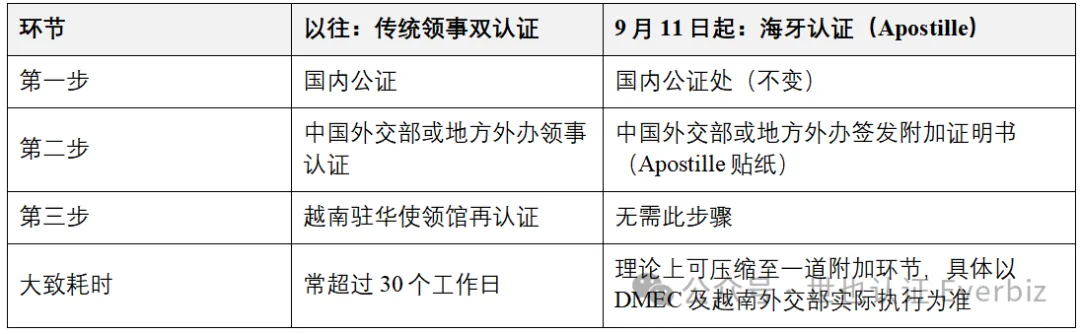
Previously, for these documents to be recognized in Vietnam, they often had to go through a multi-layer chain of “notarization – consular authentication by China’s Ministry of Foreign Affairs – re-legalization by the Vietnamese embassy or consulate in China”, which often took more than 30 days and was costly.
After the new rules take effect on 11 September, as long as documents are issued in a contracting party (mainland China, Hong Kong and Macao are all covered), in theory only one apostille obtained in the home country is needed before submission to the Vietnamese authorities, with no embassy legalization. The two models compare as follows:
4. Practical Points for Companies
-
Implementing rules are still being finalized. Vietnam’s July decree has only just clarified the scope and procedures for apostilles; whether DMEC’s registration system has been updated to accept apostilled documents should be verified with your local agent or the authority before submission – don’t assume.
-
The issuing authority and the reviewing authority are separate. In Vietnam, apostilles are issued by the Ministry of Foreign Affairs (specifically the Consular Department in Hanoi and the External Relations Department in Ho Chi Minh City), while medical device registration is reviewed by DMEC. Companies need to align the processes and timelines on both sides to avoid delays in authentication holding up registration.
-
Watch for objections by individual countries. The Convention allows contracting states to object to a new party’s accession, and some countries, such as Germany, objected to Vietnam’s accession. This generally does not affect Chinese companies (China did not object), but if your supply chain involves documents issued by other countries, check whether the Convention is in force between that country and Vietnam.
-
Documents in transition. Documents for which traditional consular legalization was started or completed before 11 September generally remain valid and need not be redone; for newly started authentications, the apostille route can be prioritized to save time and cost.
-
An apostille is not a content review. An apostille only confirms the authenticity of the signature and seal on the document; it does not substantively review the legality or truth of its content. The accuracy, validity and consistency with registration information of documents such as the CFS and LOA remain the company’s responsibility – simplified procedures are no reason to relax internal review.
5. Impact on Companies
Vietnam’s implementation of the Apostille Convention is an important step in its administrative reform and international alignment, and gives Chinese medical device companies entering Vietnam a real compliance speed-up. But simplified procedures do not mean review disappears – document authenticity, proper notarization and correct scope remain central to valid registration documents. We recommend that companies become familiar with the new process early and plan document timelines according to their product classes and registration schedules to make the most of this policy benefit.
EVERBIZ International Medical Device Registration: specializing in global medical device regulations and international registration services
From product classification, regulatory analysis and ISO 13485 system planning to overseas registration, technical documentation and local regulatory compliance, we help Chinese medical device companies enter global markets more efficiently.
If your product is entering Southeast Asia, contact us for medical device registration and ISO 13485 compliance advice for Singapore, Malaysia, Thailand, Indonesia, the Philippines, Vietnam and other markets.
EVERBIZ Certification Services (Shanghai) Co., Ltd. (EVERBIZ) is a professional compliance service platform for testing, certification, consulting and training of medical products, dedicated to helping leading medical R&D companies at home and abroad improve their compliance capabilities and competitiveness. The company has offices and branches in Shanghai (China), Hong Kong, Munich (Germany), Salzburg (Austria), Thailand, Vietnam, Singapore and Malaysia, covering nearly 25 industries of compliance products (such as medical devices, new energy, household appliances, lighting, tools, laboratory instruments, machinery, in vitro diagnostics, wireless products and reagents).
Shanghai: Room 909, Building 1, Lane 111 Luxiang Road, Baoshan District, Shanghai, China
Germany: Landsberger Str. 155, 80687 München, Germany
Austria: Innsbrucker Bundesstraße 136/3, 5020 Salzburg, Austria
Hong Kong: Room A1, 11/F Winner Building, 36 Man Yue Street, Hung Hom, Kowloon, Hong Kong
Thailand: 5/32 Baan Klang Muang Monaco, Soi Anamai, Srinakarin Rd., Pattanakarn, Suan Luang, Bangkok 10250, Thailand
Singapore: 133 New Bridge Road #8-1 Chinatown Point, Singapore 059413
Vietnam: 81 Cuxa Phu Lam D, Phuong Binh Phu, District 6, Ho Chi Minh City, Vietnam
Malaysia: Unit No. 92a, Jalan 13/142, Taman Orkid Desa, 56000 Kuala Lumpur, W.P. Kuala Lumpur, Malaysia

How Medical Device Exports to the EU Can Fail Because of the Carton
Shanghai’s Third-Party Medical Device Warehouses: An Analysis of 58 Licensed Companies
TGA Follows the EU MDR Extension: Australia’s New Transition Timeline for Medical Devices
Condom Registration in Thailand: A Medical Device Category with Its Own Legislation
Global Regulatory Convergence Accelerates: An In-Depth Look at the IMDRF Regulatory Reliance Playbook