Overview | In 2026, Singapore’s Health Sciences Authority (HSA) continued to update its guidance on medical device product registration, change notification, IVD grouping, dealer licensing and cybersecurity. For companies planning to enter Singapore or already holding SMDR registrations, the choice of registration route, document version control and post-market change management all need to be adjusted accordingly.
In recent years Singapore has continued to refine its medical device regulatory system, maintaining high entry standards while placing greater emphasis on regulatory reliance, life-cycle management and risk control for digital medical devices. Since the start of 2026, the HSA has updated a number of medical device guidance documents. Based on recent HSA publications, this article sets out the changes that matter most to companies and their practical implications.
In September 2026, the HSA published the new GN-15-R14 Guidance on Medical Device Product Registration. Alongside the registration guidance, the HSA also updated the supporting authorization, marketing history and safety declaration documents.
-
Annex 1: Letter of Authorisation
-
Annex 2: Marketing History Declaration
-
Annex 3: Safety Declaration
-
Annex 4: Label, AE, FSCA Declaration (labeling, adverse events and field safety corrective actions)
Impact on companies: companies planning to submit Class B, C or D registration applications soon should check not only the CSDT technical documents but also whether the administrative documents, declarations and letters of authorization use the current versions, to avoid queries or delays caused by old templates.
2. Deeper Regulatory Reliance: Products with Overseas Approvals Have a Route Advantage
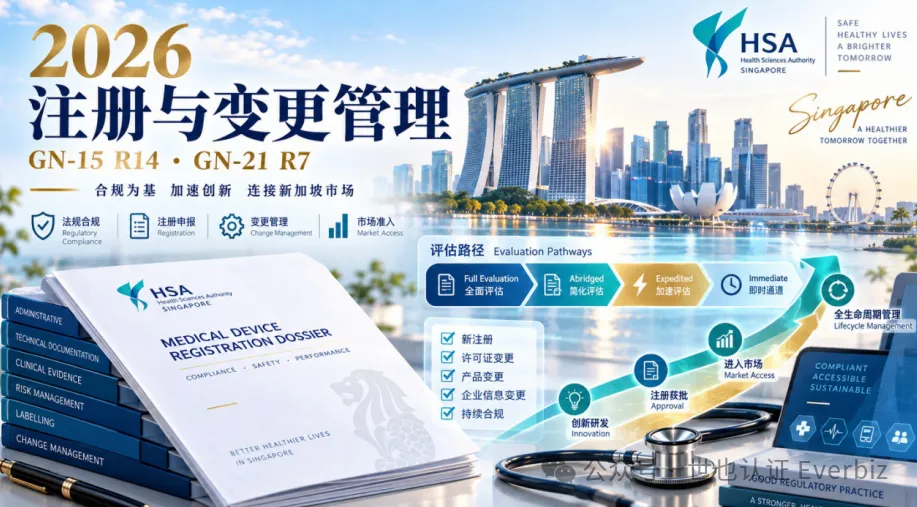
A key feature of Singapore medical device registration is that applicants can rely on evaluations by mature regulators recognized by the HSA. For Class B, C and D products, different routes – Full Evaluation, Abridged Evaluation, Expedited Evaluation, etc. – can be assessed based on prior overseas approvals and product status.
For products already approved by the US FDA, Health Canada, Japan’s MHLW or Australia’s TGA, companies should first assess whether they meet the conditions for abridged evaluation when planning their Singapore strategy, rather than defaulting to full evaluation.
Note: regulatory reliance does not mean “a certificate is enough”. The HSA still checks whether the reference-market version and the Singapore application are consistent in intended use, target population, models, labeling, IFU and safety and performance information. Where there are differences, adequate bridging or difference explanations should be prepared.
3. GN-21 Updated to R7: Post-Market Change Management Becomes a Compliance Focus
In 2026, the HSA updated GN-21, its guidance on change notification for registered medical devices. For products listed on the Singapore Medical Device Register (SMDR), when design, manufacturing, labeling, software, models or other registration information change, companies must use the latest guidance to determine whether the change is a Change Notification, an administrative update or requires re-registration.
-
Significant technical changes to Class C/D products;
-
Review Changes for Class B products;
-
Administrative changes affecting SMDR information;
-
Major adjustments to software versions, algorithms or cybersecurity;
-
Changes in manufacturing site, manufacturer or key supply chain.
EVERBIZ tip: companies should embed HSA change assessment in their global design change and regulatory change processes. Especially for software, AI devices and products with frequent model updates, the Singapore regulatory route should be determined before the change is implemented, not assessed after the fact.
4. IVD Companies Note: the “IVD Cluster” Grouping Has Been Abolished
From 2 June 2026, the HSA abolished the “IVD Cluster” grouping in GN-12-1 and continues to refine its grouping framework for IVD products. Companies that previously relied on IVD Clusters to combine several reagents or related products in one application need to reconfirm whether they meet other IVD grouping rules.
Grouping strategy directly affects the number of applications, registration fees, review complexity and future model extensions, so we recommend completing the grouping assessment before formally preparing technical documents. For analyzers, test kits and product series, whether they can be submitted as a Family or another combination should be judged based on the product owner, proprietary name, risk class, methodology and intended use.
5. Cybersecurity Regulation Moves Further Toward the Full Life Cycle
In 2026, the HSA published/updated documents on cybersecurity best practices for medical devices, further reflecting its regulatory focus on life-cycle cybersecurity management for connected devices and software medical devices. For SaMD, AI medical software, mobile health apps, cloud platforms, remote monitoring and devices with wireless connectivity, cybersecurity is no longer just a test report at the registration stage.
We recommend that companies gradually build the following documentation:
-
Cybersecurity Risk Management
-
Security Architecture / Threat Modelling
-
Vulnerability / Penetration Testing
-
SBOM (Software Bill of Materials)
-
Patch & Update Plan
-
Post-market Vulnerability Management
6. Dealer Licensing and Local Compliance Requirements Updated at the Same Time
Entering the Singapore market is not complete once the product is registered. For overseas manufacturers it usually also involves a local Registrant, Importer/Wholesaler Licence and applicable quality system requirements. In 2026 the HSA continued to update its guidance on manufacturer, importer and wholesaler licensing; companies should keep track of their local partners’ license status, premises, quality system certificates and authorization relationships.
For Chinese companies using a local agent model, we recommend including both “product registration capability” and “ongoing compliance capability” in agent selection criteria, to avoid supply being affected later by license maintenance or quality system issues.
7. Regulatory Trend: More Centralized, Coordinated and Covering the Full Product Life Cycle
The series of updates in 2026 shows that Singapore’s medical device regulation is advancing in two directions at once: reducing unnecessary duplicate review through regulatory reliance and differentiated evaluation routes, and strengthening life-cycle compliance through change management, cybersecurity, dealer licensing and post-market surveillance.
For AI medical devices, SaMD and combined hardware-software products, the regulatory focus is likely to extend further from “pre-market technical review” to continuous updates, cybersecurity, post-market surveillance and coordination of responsibilities between parties.
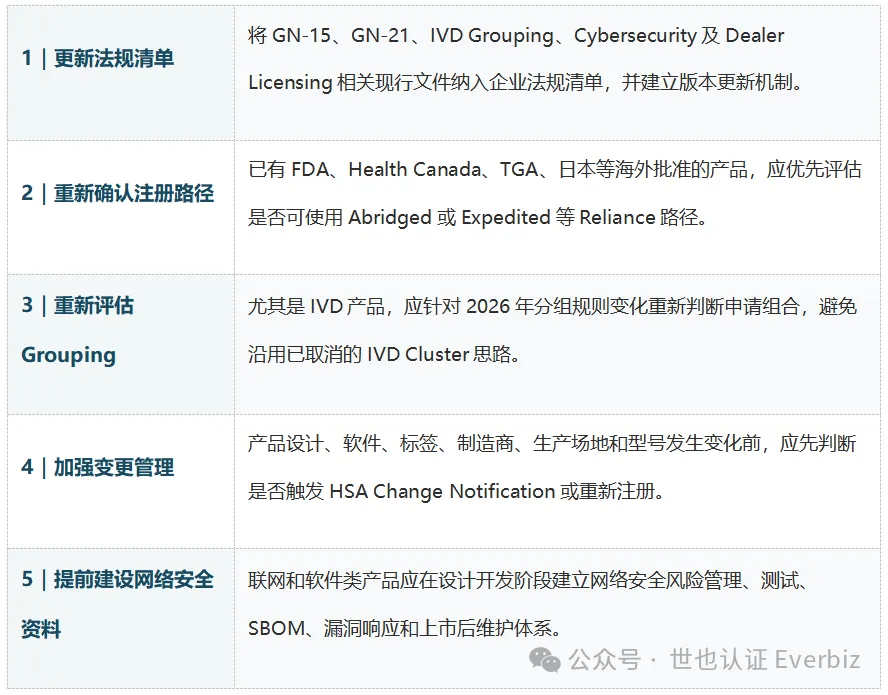
EVERBIZ recommends: 5 things to focus on now
Conclusion
For Chinese medical device companies planning to enter Southeast Asia, Singapore remains a regulatory market of strategic value. Its registration system is closely aligned with the ASEAN CSDT framework, and a well-structured, evidence-complete Singapore dossier also lays a good foundation for subsequent entry into Malaysia, Thailand, Indonesia, Vietnam and other markets.
EVERBIZ will continue to follow Singapore HSA and Southeast Asian medical device regulations, providing global registration, regulatory consulting and technical documentation support for medical device companies.