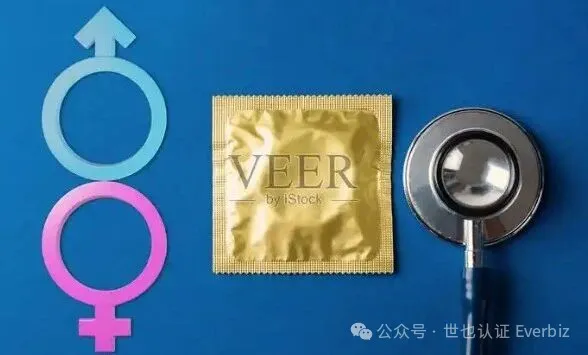
In most countries’ medical device classification systems, condoms are just one of many low-risk products. In Thailand, however, their status is special – they were the first product category in Thai medical device regulatory history to be covered by dedicated legislation, with a set of mandatory standards and testing requirements more detailed than those for ordinary Class 1/2 devices.
For condom manufacturers planning to export to Thailand, understanding these “extra rules” is the first step to avoiding detours.
The parent law of Thai medical device regulation is the Medical Device Act, first issued in 1988 (B.E. 2531). The current version is the 2008 revision (B.E. 2551), further updated by the second amendment of 2019 (B.E. 2562).
Condoms are special because, beyond the parent law, the Ministry of Public Health has issued a separate ministerial notification specifically for them – the Notification of the Ministry of Public Health on Condoms – first issued in 1989 (B.E. 2532), with the current version being the 2013 (B.E. 2556) revision.
This dedicated notification sets out the standards and requirements condoms must meet as medical devices, including mandatory product quality standards, size classification, batch-by-batch testing and labeling rules, forming the core basis for condom registration and distribution in Thailand. Because of this notification, condoms are regulated at a noticeably finer level of detail than most ordinary medical devices.
Standard registration route: which Thai FDA channel
Day-to-day regulation of condoms is handled by the Medical Device Control Division (MDCD) of the Thai Food and Drug Administration (Thai FDA), and all submissions must be made via the SKYNET e-submission system.
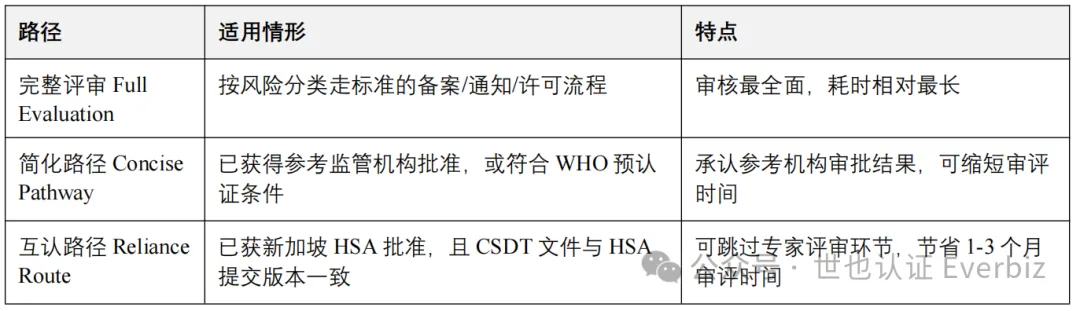
Thailand’s medical device classification is aligned with the ASEAN Medical Device Directive (AMDD), with risk classes from Class 1 to Class 4 corresponding to different registration types (listing, notification or license). Companies currently have three main registration routes:
Note that whichever route is used, overseas manufacturers must first appoint a local authorized representative or License Holder in Thailand holding a valid Establishment License to make the registration submission on their behalf – foreign companies cannot submit applications directly to the Thai FDA in their own name.
Special requirements for condoms: more hurdles than ordinary devices
1. Mandatory Thai Industrial Standard (TIS)
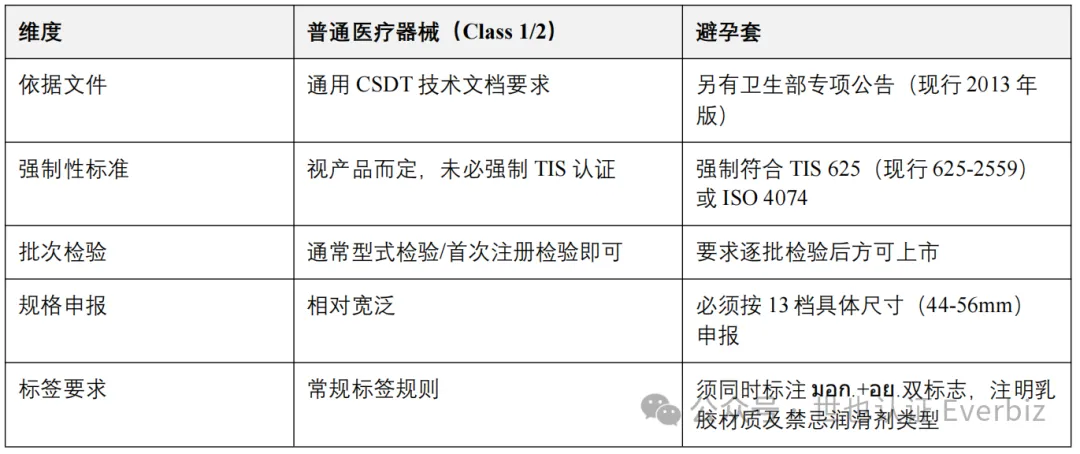
Technical documentation for ordinary medical devices usually follows the general CSDT route and may not require an additional mandatory product certification mark. But as regulated rubber products, condoms must comply with Thai Industrial Standard TIS 625 (latest version 625-2559) or the equivalent international standard ISO 4074, testing physical/mechanical properties such as burst and freedom from holes.
2. Batch-by-batch testing – a one-off type test is not enough
Most medical devices only need type testing at initial registration, with production consistency then maintained through the quality system. But every batch of condoms must be tested before being placed on the market, by laboratories of the Department of Medical Sciences (กรมวิทยาศาสตร์การแพทย์) of the Ministry of Public Health, with sampling and batch acceptance according to TIS 465 or ISO 2859-1. Companies therefore need to budget time and cost for ongoing batch testing rather than planning on “register once, sell long-term”.
3. Mandatory 13-size classification
Under the Thai Industrial Standard, condoms are classified by their flat width (half the circumference) into 13 sizes from 44, 45, 46… up to 56 mm. Applications must specify the exact size; vague descriptions such as “one size” or “universal size” are not accepted. In practice, products on the market are mainly 49 mm and 52 mm.
4. “Dual mark” requirements for labels and packaging
Both the outer box and the individual foil sachets must bear both มอก. (the Thai Industrial Standards certification mark) and อย. (the Thai FDA medical device license mark), together with the statement “made of natural rubber latex” and the corresponding medical device license number.
In addition, because latex condoms cannot be used with oil-based lubricants (oils degrade the rubber, causing ageing and breakage), compatibility warnings of this kind are usually also mandatory label content – something uncommon in labeling rules for ordinary medical devices.
What Chinese exporters usually need to prepare
Combining standard Thai FDA medical device registration requirements with the condom-specific rules, Chinese manufacturers exporting to Thailand generally need the following core documents:
-
Technical documentation in CSDT format demonstrating safety, performance and quality;
-
A Certificate of Free Sale (CFS) from the country of origin – if the product is not registered in China, an equivalent certificate from the regulator of a third country (such as a market where registration has been completed) may be considered; confirm the route with your local agent in advance;
-
Test reports to TIS 625/ISO 4074 demonstrating compliant physical performance;
-
Product label and packaging artwork (showing the มอก. and อย. marks and Thai instructions);
-
ISO 13485 quality management system certificate;
-
Letter of authorization to the local authorized representative/License Holder and a copy of its Establishment License.
Summary
The regulation of condoms in Thailand is a good example of how, within the same country and under the same medical device parent law, different product categories can be regulated at very different levels of detail – often directly linked to the product’s public health significance. Condoms have long played an important role in Thailand’s HIV/AIDS prevention, which is the practical reason for their special treatment of “dedicated legislation + batch-by-batch testing”.
For companies planning to export to Thailand, understanding in advance the additional requirements layered on top of the general registration process – mandatory standards, batch testing, size classification and dual-mark labeling – allows a more accurate assessment of compliance costs and timelines, avoiding discovering gaps only when approaching submission or production.
EVERBIZ International Medical Device Registration: specializing in global medical device regulations and international registration services
From product classification, regulatory analysis and ISO 13485 system planning to overseas registration, technical documentation and local regulatory compliance, we help Chinese medical device companies enter global markets more efficiently.
If your product is entering Southeast Asia, contact us for medical device registration and ISO 13485 compliance advice for Singapore, Malaysia, Thailand, Indonesia, the Philippines, Vietnam and other markets.
EVERBIZ Certification Services (Shanghai) Co., Ltd. (EVERBIZ) is a professional compliance service platform for testing, certification, consulting and training of medical products, dedicated to helping leading medical R&D companies at home and abroad improve their compliance capabilities and competitiveness. The company has offices and branches in Shanghai (China), Hong Kong, Munich (Germany), Salzburg (Austria), Thailand, Vietnam, Singapore and Malaysia, covering nearly 25 industries of compliance products (such as medical devices, new energy, household appliances, lighting, tools, laboratory instruments, machinery, in vitro diagnostics, wireless products and reagents).
Shanghai: Room 909, Building 1, Lane 111 Luxiang Road, Baoshan District, Shanghai, China
Germany: Landsberger Str. 155, 80687 München, Germany
Austria: Innsbrucker Bundesstraße 136/3, 5020 Salzburg, Austria
Hong Kong: Room A1, 11/F Winner Building, 36 Man Yue Street, Hung Hom, Kowloon, Hong Kong
Thailand: 5/32 Baan Klang Muang Monaco, Soi Anamai, Srinakarin Rd., Pattanakarn, Suan Luang, Bangkok 10250, Thailand
Singapore: 133 New Bridge Road #8-1 Chinatown Point, Singapore 059413
Vietnam: 81 Cuxa Phu Lam D, Phuong Binh Phu, District 6, Ho Chi Minh City, Vietnam
Malaysia: Unit No. 92a, Jalan 13/142, Taman Orkid Desa, 56000 Kuala Lumpur, W.P. Kuala Lumpur, Malaysia