In FDA submissions for medical devices, biocompatibility assessment is an unavoidable core element. The FDA guidance Use of International Standard ISO 10993-1 (the “FDA general guidance”), the FDA guidance Chemical Analysis for Biocompatibility Assessment of Medical Devices (the “FDA chemistry guidance”) and ISO 10993-1 are the three “programmatic documents” for biocompatibility compliance.
Many companies confuse the roles of the three – either treating the international standard directly as the FDA requirement, or overlooking key details of chemical characterization – leading to repeated requests for additional information and stalled reviews.
Today we clarify everything at once:
(1) what each of the three documents covers, how they divide the work and how to use them together in a submission;
(2) other FDA biocompatibility guidance documents;
(3) the steps for submitting FDA biocompatibility documentation.
-
ISO 10993-1: the International Organization for Standardization’s global “master framework” for biocompatibility assessment. The FDA currently recognizes only the 2018 edition.
-
The FDA general guidance is the “US implementation manual” for ISO 10993-1. It governs the overall biocompatibility assessment for all FDA submissions (510(k)/PMA/De Novo/IDE) and is the “top-level basis” for FDA review.
-
The FDA chemistry guidance is a purely technical, highly practical implementation document applying wherever chemical characterization is needed (new materials, high-risk devices, material changes, coatings/additives, etc.) – the “technical yardstick” for submissions.
When preparing a biocompatibility assessment, the FDA general guidance tells you “when chemical characterization is mandatory” (e.g. new materials, high-risk implants, long-term contact, formulation changes). The FDA chemistry guidance tells you “the technical minimum requirements for chemical characterization” (e.g. simulating clinical conditions, method validation, level of identification of unknowns).
The complete process for using the three documents “together”
Priority of chemical characterization – ISO and FDA differ completely: (1) under ISO 10993-1, chemical characterization is an “optional supplement”, and existing data can be used first to waive testing; (2) under the FDA general guidance, chemical characterization is a “mandatory prerequisite” – high-risk devices must undergo chemical characterization first before deciding whether animal testing is needed; (3) following ISO thinking and going straight to animal testing without chemical characterization leads to an immediate FDA deficiency letter.
Test waivers – FDA stricter, ISO more flexible: (1) ISO: many tests can be waived as long as there is sufficient data/literature support; (2) FDA: waiver conditions are very strict – you must demonstrate that “material formulation, process, leachables and clinical contact” are identical to a safe marketed device; (3) writing FDA documents using ISO waiver logic leads to requests for additional chemical characterization and testing.
Requirements for unknowns – FDA far stricter than ISO: (1) ISO: no explicit mandatory requirement to identify unknowns; (2) FDA chemistry guidance: unknowns ≥0.5 μg/mL must be identified; if identification is not possible, a “scientific rationale for why it cannot be identified + additional toxicological assessment” is required. Quantifying unknowns without identifying them leads to outright rejection.
The FDA biocompatibility framework also includes other guidance documents, which together form a complete programmatic system giving companies a full framework for their submission:
The FDA Recognized Consensus Standards database (dynamically updated) is the FDA’s only official list of recognized test standards. On 22 December 2025, 117 standards were updated at once, including:
-
ISO 10993-4 AMD1:2025: stricter hemolysis/coagulation provisions for blood-contacting devices, with a new “dynamic coagulation index ≤5%” requirement;
-
ASTM F754-24: tensile test specimen size for PEEK materials changed from 6 mm to 4 mm;
-
ASTM F366-24: R-ratio for bone plate fatigue testing changed from 0.1 to 0.2;
-
Applications submitted after 1 January 2026 must cite the latest versions of standards, and gap analyses are needed for old reports
FDA Recognized Consensus Standards database:
https://www.accessdata.fda.gov/scripts/cdrh/cfdocs/cfStandards/search.cfm
The FDA general guidance provides an officially recommended summary table template – the only official format recognized in FDA submissions. Attachment C provides the FDA’s recommended biocompatibility information summary table, used to present all biocompatibility assessment results clearly in the submission. The table includes the following core columns:
-
Biocompatibility endpoint (e.g. cytotoxicity, sensitization, irritation, systemic toxicity);
-
Assessment method (testing/literature/clinical data/chemical characterization);
-
Data source (test report number/literature reference/comparison with a marketed device), etc.
FDA programmatic documents for special products.
-
The combination product biocompatibility guidance, Guidance for Industry: Biological Evaluation of Combination Products, specifically addresses biocompatibility assessment of drug-device combination products, evaluating the effect of drug release characteristics on device biocompatibility and drug-device interactions; both drug and device regulatory requirements must be met.
-
Device-type-specific guidance, Guidance for Blood-Contacting Devices, covers special requirements for blood-contacting devices (such as catheters and oxygenators), e.g. the new “dynamic coagulation index ≤5%” requirement added in 2025.
-
The Guidance for Implantable Devices covers special biocompatibility requirements for implantable devices, emphasizing assessment of local effects after implantation and safety evaluation of long-term degradation products.
United States Pharmacopeia (USP) standards – the implicit framework in FDA regulatory practice. Several warning letters issued by the FDA in recent years about biocompatibility data quality have revealed shortcomings in testing. Although warning letters are not formal guidance, they represent the FDA’s actual regulatory position and are an “implicit framework” companies must heed.
We recommend that companies read the FDA general guidance, refer to applicable device-specific guidance and Class II special controls documents for any relevant device-specific biocompatibility information, and follow these submission steps:
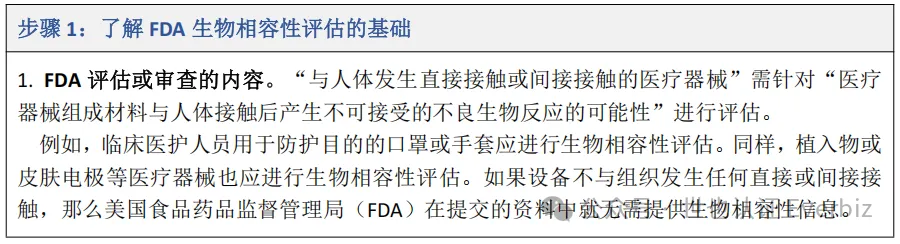
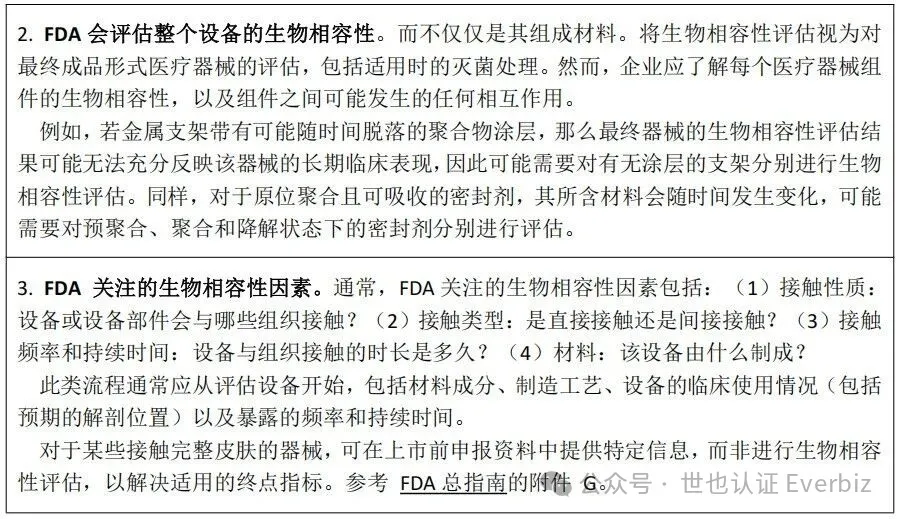
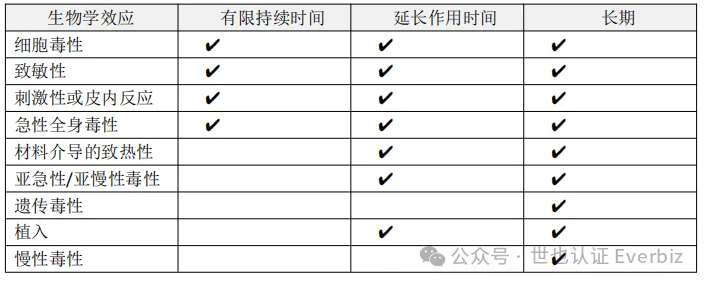
 1. Surface device: intact skin
 2. Surface device: mucosal membrane
 3. Surface device: breached or compromised surface
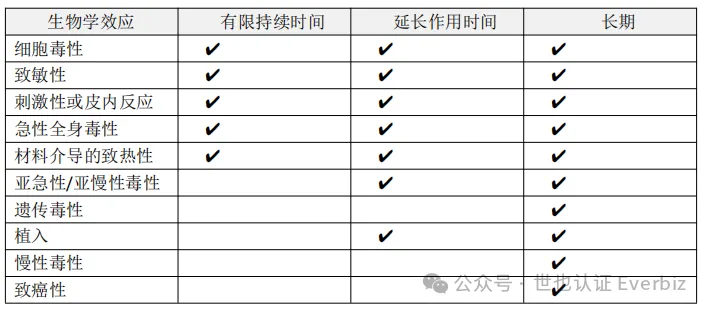 In addition to the endpoint tables by device category, there are endpoint tables for externally communicating devices and implant devices, covering:
The FDA guidance documents are as follows:
In addition to the endpoint tables by device category, there are endpoint tables for externally communicating devices and implant devices, covering:
The FDA guidance documents are as follows:
-
-
The Accreditation Scheme for Conformity Assessment (ASCA) Program
-
Chemical Analysis for Biocompatibility Assessment of Medical Devices
Download link: https://www.everbiz.com.cn/ziliaoxiazai/show228.html
Conclusion
This is a series of educational articles introducing regulations and standards of the FDA, NMPA, GMP, CE MDR/IVDR and MDSAP.
EVERBIZ is happy to share medical device expertise with industry clients, and hopes our extensive practical experience in quality systems and product registration will be helpful.
Let’s contribute together to the development of the medical device industry – if you have any questions or needs, please contact us.
EVERBIZ Certification Services (Shanghai) Co., Ltd. (EVERBIZ) is a professional compliance service platform for testing, certification, consulting and training of medical products, dedicated to helping leading medical R&D companies at home and abroad improve their compliance capabilities and competitiveness. The company has offices and branches in Shanghai (China), Hong Kong, Munich (Germany), Salzburg (Austria) and Thailand, covering nearly 25 industries of compliance products (such as medical devices, new energy, household appliances, lighting, tools, laboratory instruments, machinery, in vitro diagnostics, wireless products and reagents).
Shanghai: Room 909, Building 1, Lane 111 Luxiang Road, Baoshan District, Shanghai, China; Germany: Landsberger Str. 155, 80687 München, Germany
Austria: Innsbrucker Bundesstraße 136/3, 5020 Salzburg, Austria
Hong Kong: Room A1, 11/F Winner Building, 36 Man Yue Street, Hung Hom, Kowloon, Hong Kong
Thailand: No. 850 Soi Lat Krabang 30/5, Lat Krabang Subdistrict, Bangkok 10520
