
Part 2: IFUs, the Chain of Responsibility and a Self-Check List
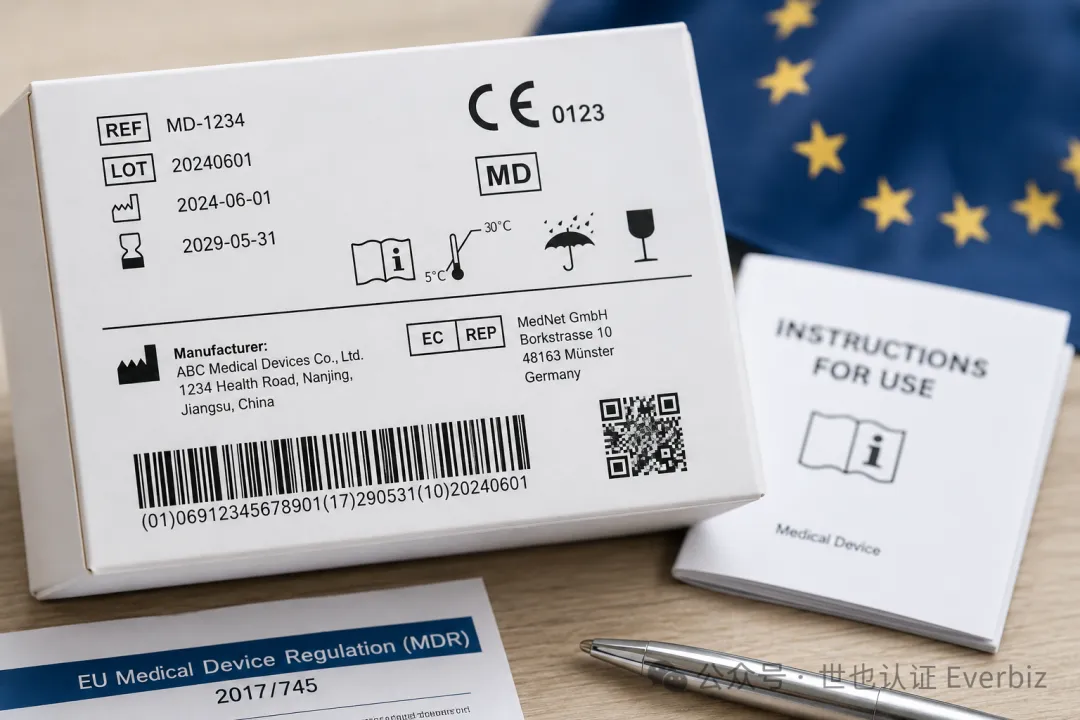
Part 1 covered the six most frequent gaps in the label itself, and one thing that is most often misunderstood – symbols are not decoration. MDR 23.1(h) requires internationally recognized symbols to be used where appropriate, in line with applicable harmonized standards or common specifications (CS); but this cannot be simplified to “whenever a standard symbol exists, it must always be used”.
Part 2 continues with the seven items most often missed in the instructions for use under GSPR 23.4, the full chain of responsibility from manufacturer to distributor, and finally a self-check list you can use directly against your print proofs.
Scope: Regulation (EU) 2017/745 (MDR, Medical Device Regulation) and Regulation (EU) 2017/746 (IVDR, In Vitro Diagnostic Medical Devices Regulation).
Unless otherwise stated, article numbers in the text refer to the MDR; the IVDR’s information requirements are similar but the corresponding article numbers differ and should be checked separately.
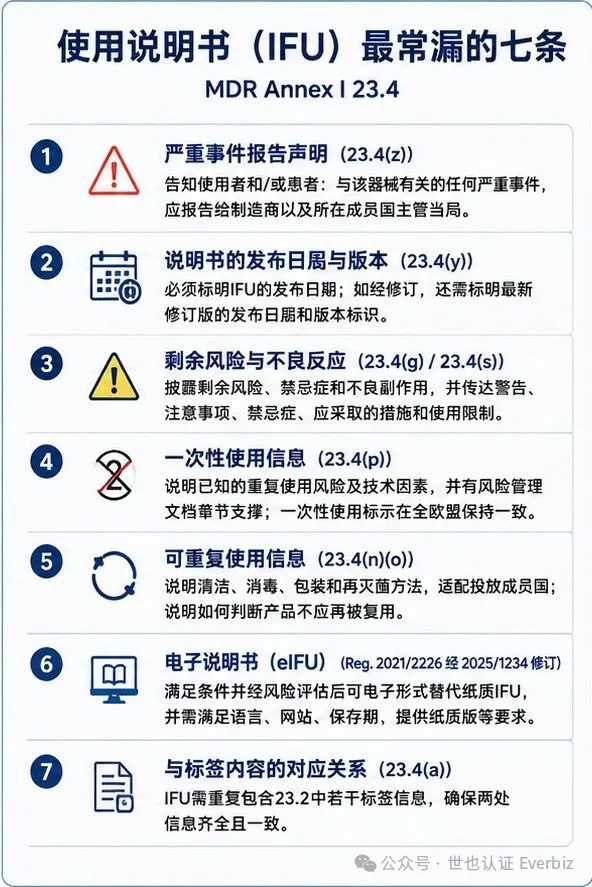
4. Instructions for Use: the Seven Items Most Often Missed in 23.4
Section 23.4 runs from (a) to (ab) – here we pick only the items that most often go wrong
1. Statement on reporting serious incidents 23.4(z)
The most frequently missed item. The IFU must include a notice to the user and/or patient that any serious incident in relation to the device should be reported to the manufacturer and the competent authority of the Member State in which the user and/or patient is established. It’s one sentence, but without it you have a non-conformity.
2. IFU issue date and version 23.4(y)
The date of issue of the IFU must be stated; if revised, the date of issue and identifier of the latest revision must also be given. This is also the lever for document control – without a version number, change traceability and IFU updates triggered by PMS (post-market surveillance) will get out of control.
3. Residual risks and undesirable side effects 23.4(g)
The IFU should disclose the residual risks, contraindications and undesirable side-effects that need to be communicated to users and/or patients, forming a closed loop with risk management, clinical evaluation and post-market surveillance. Many companies only write “precautions” and omit contraindications or undesirable side-effects – these cannot simply substitute for one another.
The companion requirement is 23.4(s): warnings, precautions, contraindications, measures to be taken and limitations of use must all be made known to the user.
4. For single use, “single use” alone is not enough 23.4(p)
If a product is labeled as single use, the IFU must also describe the known characteristics and technical factors that could pose a risk if the device were reused, and this information must be supported by a dedicated section of the risk management documentation. Even if the product legally does not require an IFU, this information must be made available to users on request.
Another often-overlooked rule: the manufacturer’s indication of “single use” must be consistent across the EU – different statements may not be given in different Member States.
5. Complete reuse information for reusable products 23.4(n)(o)
Cleaning, disinfection, packaging and, where appropriate, validated resterilization methods must be described, adapted to the Member States where the product is placed on the market; the IFU must also explain how to identify when the product should no longer be reused (signs of material degradation, maximum number of allowable reuses, etc.).
6. Electronic IFUs aren’t automatically allowed Reg. (EU) 2021/2226 (as amended by 2025/1234)
An electronic IFU (eIFU) is not just a PDF on a website. Commission Implementing Regulation (EU) 2021/2226 has been amended by Regulation (EU) 2025/1234: for MDR devices intended for professional users, the paper IFU may be replaced by an electronic one if specified conditions are met and a documented risk assessment is performed; if lay use is reasonably foreseeable, a paper IFU must still be provided for lay users.
Some easily missed requirements:
The provision of the eIFU must be supported by a documented risk assessment demonstrating that the electronic form maintains or improves the level of safety of the paper IFU
The IFU must be available in the official EU languages required by the Member States where the device is placed on the market; previous electronic versions and their dates of issue must be available for the required retention period, and outdated versions provided on request
The website should use a common format readable with free software, protect against unauthorized access and tampering, and comply with the GDPR
Paper versions must be provided free of charge on request, within 7 calendar days of receiving the request at the latest, or with the device if requested at the time of ordering
The label must clearly indicate that the IFU is provided electronically and how to access it; the website address must be stable and directly accessible for the required retention period
Retention period: for non-implantable devices with a defined expiry date, at least 10 years after the last device is placed on the market, and at least 2 years after the expiry of the last device produced; for devices without a defined expiry date and implantable devices, at least 15 years after the last device is placed on the market
7. Correspondence with label content 23.4(a)
MDR 23.4(a) explicitly requires the IFU to repeat certain label information from 23.2 (including product name, manufacturer, information on specific substances where applicable, storage conditions, sterile status, single-use indication, etc.). In practice, we recommend preparing a 23.2–23.4 cross-reference table to avoid information “on the box but not in the IFU” or inconsistencies between the two.
A word on language
The language of the information supplied is determined by the Member State where the device is made available, and the same Member State may have different language requirements for professional and lay-use products. If a SKU is to be sold in several countries, confirm the language rules of those countries first – rather than discovering after printing that you need to reprint.
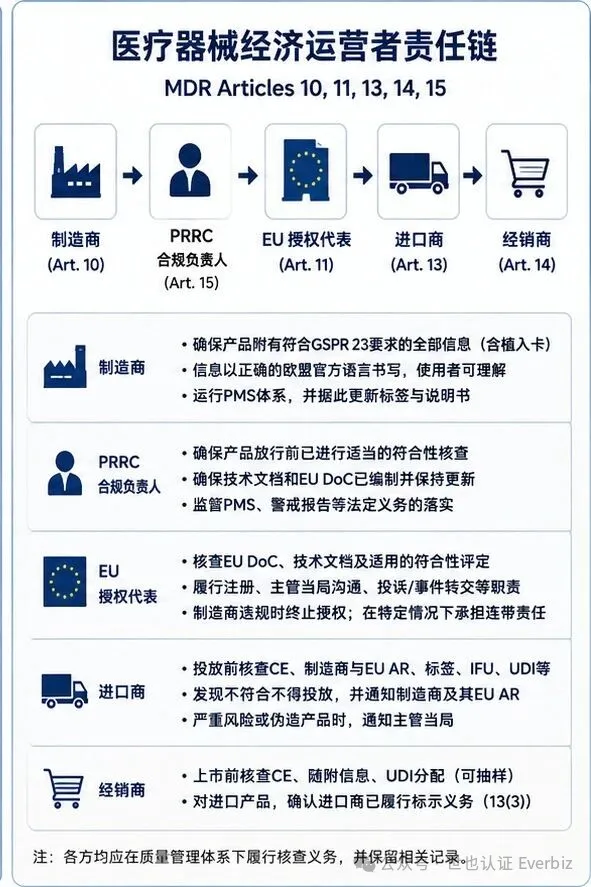
5. Label Compliance Is Not Just the Manufacturer’s Job
Every link in the chain of economic operators has verification obligations
This is especially important for EU ARs, importers and distributors – many people think only the manufacturer is held accountable for labeling problems, but that is not the case.
Manufacturer (Article 10): ensures the device is accompanied by all information required by GSPR 23 (including the implant card where applicable), in the correct official EU languages and understandable by the intended user; also operates the PMS system and updates labels and IFUs accordingly.
Person Responsible for Regulatory Compliance (PRRC, Article 15): at a minimum ensures that the conformity of devices is appropriately checked under the quality management system before release, that the technical documentation and EU DoC are drawn up and kept up to date, and oversees statutory obligations such as PMS and vigilance reporting.
EU Authorized Representative (Article 11): within the scope of the mandate, verifies the EU DoC, technical documentation and applicable conformity assessment, and carries out registration, communication with competent authorities and forwarding of complaints/incidents; must terminate the mandate if the manufacturer acts contrary to its obligations. If a non-EU manufacturer fails to fulfil its Article 10 obligations, the authorized representative is jointly and severally liable with the manufacturer for defective devices.
Importer (Article 13): before placing a device on the market, must verify that it bears the CE marking, the manufacturer is identified, an authorized representative has been designated under Article 11, the labeling complies with the regulation, the required IFU is supplied and a UDI has been assigned under Article 27. Where non-conformity is found, the device may not be placed on the market until it is brought into conformity, and the manufacturer and its authorized representative must be informed; if the device presents a serious risk or is falsified, the competent authority of the Member State must also be informed.
Distributor (Article 14): before making a device available, must likewise verify the CE marking, information supplied and UDI assignment, and may use a sampling method; for imported devices, must also confirm that the importer has complied with its labeling obligations under Article 13(3).
Article 16(2) applies more widely than you might think
Translating the information supplied by the manufacturer, adding necessary information to market the device in a Member State, and changing the outer packaging (including pack size) where conditions are met may all fall under Article 16(2). The importer or distributor concerned must have a quality management system ensuring that translations are accurate and up to date, that the activities do not affect the original condition of the device, and that it can receive the manufacturer’s safety corrective information.
At least 28 days before making a relabeled or repackaged device available, the manufacturer and the competent authority of the Member State concerned must be notified; on request, samples or mock-ups must be provided, and a QMS certificate issued by an appropriate notified body must be submitted to the competent authority.
For sterile devices, if repackaging opens, damages or otherwise affects the packaging necessary to maintain sterility, the original condition of the device is presumed to be adversely affected – so it cannot simply be said that “no outer packaging may ever be changed” for sterile products.
6. A Self-Check List You Can Use Directly
We recommend going through it before finalizing print proofs – far cheaper than reprinting
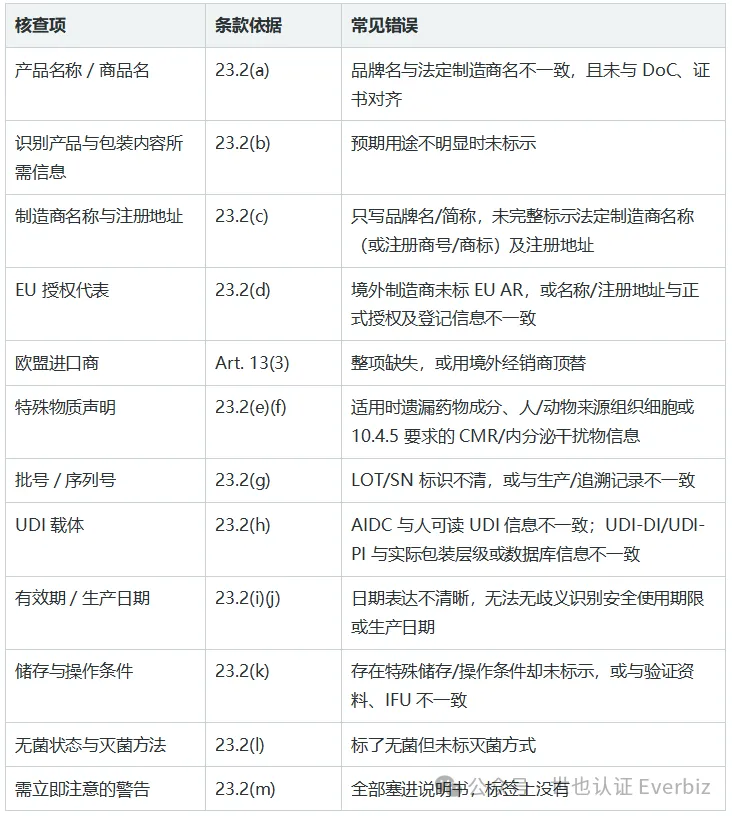
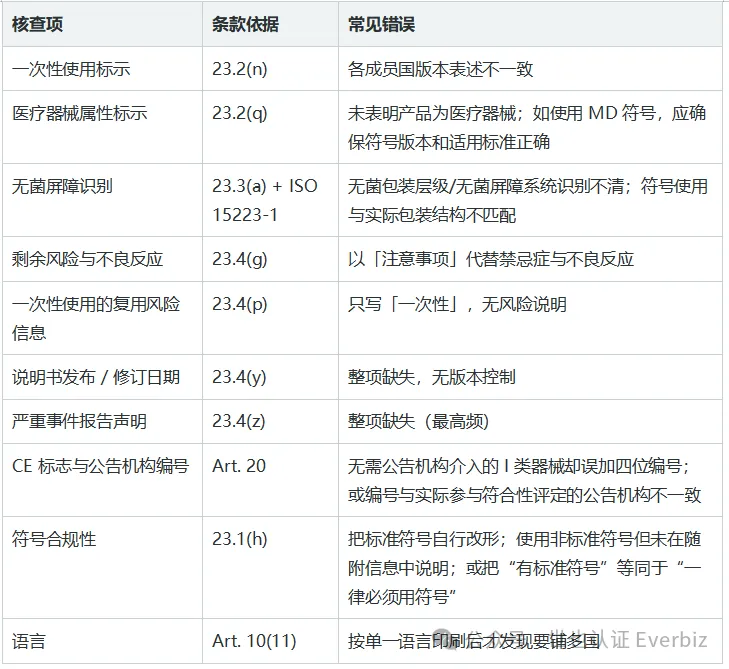
This list is an extract of common items and is not a complete list of GSPR 23 requirements; specific product categories (implantable, active, ophthalmic optics, reusable devices, etc.) have additional specific standard requirements.
Looking at the clauses across both articles, you’ll notice a common thread: many frequent non-conformities don’t involve core product design or processes, but rather information, versions, role responsibilities and pre-market checks that weren’t done thoroughly.
Of course, if label/IFU changes reflect changes in risk, intended use or performance, they may also trigger updates to technical documentation, risk management, clinical evaluation or even verification activities – it cannot be assumed that “only the text changes and nothing else is affected”.
Labels and IFUs are the part of EU compliance most worth systematically checking before market launch. We recommend cross-checking GSPR 23.2, 23.3 and 23.4 item by item against 1:1 print proofs, the IFU, EU DoC, UDI data and technical documentation before finalizing artwork; this costs far less than reprints, withdrawals or corrective actions after launch.
Main references
1. Regulation (EU) 2017/745 (MDR), Annex I Chapter III Section 23; Articles 10, 11, 13, 14, 15, 16, 18, 20, 27; Annex V
2. Corresponding provisions of Regulation (EU) 2017/746 (IVDR) (GSPR 20.1/20.4)
3. Commission Implementing Regulation (EU) 2021/2226 (electronic instructions for use) and Commission Implementing Regulation (EU) 2025/1234 (2025 amendment)
4. Commission Implementing Regulation (EU) 2020/1207 (common specifications for reprocessing single-use devices)
5. EN ISO 15223-1:2021 + EN ISO 15223-1:2021/A1:2025 Medical devices – Symbols to be used with information to be supplied by the manufacturer – Part 1: General requirements
6. MDCG 2018-8, MDCG 2019-8, MDCG 2021-11 (implant card guidance)
7. Commission Implementing Decision (EU) 2026/1231 (updated list of MDR harmonized standards, including EN ISO 15223-1:2021/A1:2025)



Introduction to EU AI Medical Device Compliance
Hyaluronic Acid Fillers Going to Southeast Asia: Regulatory Focus Points and Document Checklist
Introduction to the GDPR (General Data Protection Regulation) for EU Medical Devices
PPWR – Is Your Packaging Ready?
A Detailed Guide to the Medical Device Classification Determination Procedure