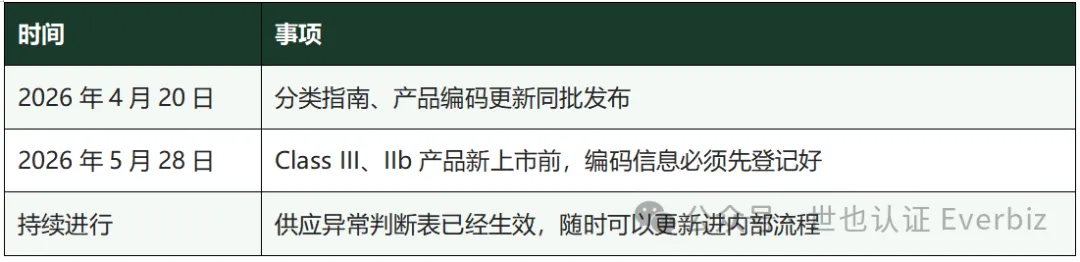
On 20 April 2026, the EU Medical Device Coordination Group (MDCG) updated its classification guidance, officially MDCG 2021-24 Rev.1. This is the first revision since the guidance was published in 2021, and on the same day the product nomenclature and a supply-disruption decision table were also updated.
Officially, the update “mainly clarifies and makes no major changes”. But for some products, this “clarification” actually tightens classification – products that could previously avoid being classed as implantable because “no surgery was involved” may no longer be able to rely on that argument. You don’t need to read dozens of pages of official documents: this article sets out what ordinary manufacturers need to know, and you can complete a self-check in 10 minutes.

If your product meets any of the following, this update concerns you and you should read on carefully:
The product remains in the patient’s body long-term (more than 30 days) via a catheter, puncture needle, electrode lead or similar, rather than being placed surgically.
Common examples: indwelling urinary catheters, implantable ports, neurostimulation electrode leads, long-term vascular access devices.
The product has automatic control or autonomous software decision-making functions – the device makes judgments and adjustments itself, not relying entirely on manual operation.
Common examples: closed-loop insulin pumps, ventilators with automatic parameter adjustment, diagnostic devices with AI-assisted decision functions.
The product’s composition or intended use is unusual or borderline, and you have previously discussed with regulators “is this really a medical device” or “which class does it belong to”.
Common examples: device-device and device-drug combination products, aesthetic laser devices, dressings with complex compositions.
None of the three apply? This update will hardly affect you – skip to the timing reminder at the end. If any apply, read on to Step 2.
Step 2: Do These 3 Things
Thing 1: Review your product’s classification rationale
Find the rationale written when the product was originally classified (usually in the technical documentation) and check whether it says something like “not placed surgically, therefore not implantable”. This update extends the definition of “implantable” from “surgical means” to “any clinical means” – in other words, a product placed via a catheter or puncture needle and remaining for 30 days may now also be considered implantable.
If it doesn’t hold: there’s no need to reapply immediately, but we recommend correcting it in the next routine technical documentation update – much better than being asked about it during an audit.
Thing 2: Check your product codes
The EU’s nomenclature for medical devices (EMDN) has also been updated, with some codes modified and others withdrawn. These codes are used in the EU registration system (EUDAMED); if your product’s code is among those changed, you need to update the registration information, otherwise the product’s registration status in the system may be affected.
Self-check: find the codes registered for your products in the system and compare them against the official update list.
Special note: for higher-risk products (Class IIb, III), after 28 May 2026 the code information must be registered before a new product is placed on the market – getting stuck here will directly affect your launch date.
Thing 3: Update your internal contingency procedure
EU regulations have always required companies to notify the competent authority when product supply is interrupted or discontinued. This time, an official, clearer decision table helps companies judge “when a situation must be reported”.
Self-check: pass the decision table to your supply chain and regulatory colleagues and confirm who currently makes this judgment in the company and on what basis.

Comparing the old and new interpretation

3. Frequently Asked Questions
Do certified legacy products need to be reapplied for proactively?
Not immediately. If Step 1 shows that the classification rationale no longer holds, add it to the plan for the next routine technical documentation update.
Is this update binding? What happens if I don’t change anything?
The guidance itself is not law and is not legally binding. But the notified body reviewing your product will essentially apply this interpretation, so in practice the effect is little different from “mandatory” – changing things only when asked during an audit puts you on the back foot.
If the product code changes but the product itself doesn’t, is that a change?
A pure code adjustment is generally treated as data maintenance and does not require the full product change procedure, but we recommend keeping a record of the reason and date of the change for future reference.
Timing Reminder
EVERBIZ summary:
This update does not change the legal text itself – it changes “how it is interpreted”. For most manufacturers, first decide whether it affects you; if it does, go through the 3 things above and you won’t miss anything. Usually only a small number of products actually need adjusting – but if yours are among them, the sooner you act, the better.
EVERBIZ International Medical Device Registration:
We specialize in global medical device regulations and international registration services, helping Chinese medical device companies enter global markets more efficiently. If your product is going overseas, contact us for registration and compliance advice for Singapore, Malaysia, Thailand, Indonesia, the Philippines, Vietnam and other markets.