
EVERBIZ | EU MDR/IVDR Regulatory Update

On 28 May 2026, the first four modules of the European database on medical devices, EUDAMED, became mandatory. Many companies breathed a sigh of relief after registering their new products, but it is easy to overlook the second milestone that follows –
28 November 2026: the deadline for registering existing devices. As of 14 October, only 45 days remain.
Based on the original EU legal texts and European Commission notices, EVERBIZ sets out what you need to know: which products must be registered, when the deadline is, and what to do now.
1. Getting the Four Dates Straight
Information circulating online often confuses “publication date”, “date of entry into force” and “deadline”. We have checked each against the official documents:
| Date | Nature | Content |
|---|---|---|
| 2024-07-09 | Regulation in force on publication | Regulation (EU) 2024/1860 amends the MDR/IVDR to allow EUDAMED to become mandatory module by module |
| 2025-11-26 / 11-27 | Decision adopted / published in the OJEU | Commission Decision (EU) 2025/2371 announces that the first four modules are functional, starting a 6-month transition period |
| 2026-05-28 | Mandatory use date | The actor registration, UDI/device registration, notified bodies and certificates, and market surveillance modules become mandatory |
| 2026-11-28 | Deadline for registering existing devices | Legacy devices and MDR/IVDR devices placed on the market before 28 May and still being placed on the market afterwards must be registered |
| 2027-05-28 | Certificate back-fill deadline | Notified bodies upload MDR/IVDR certificates issued before 28 May |
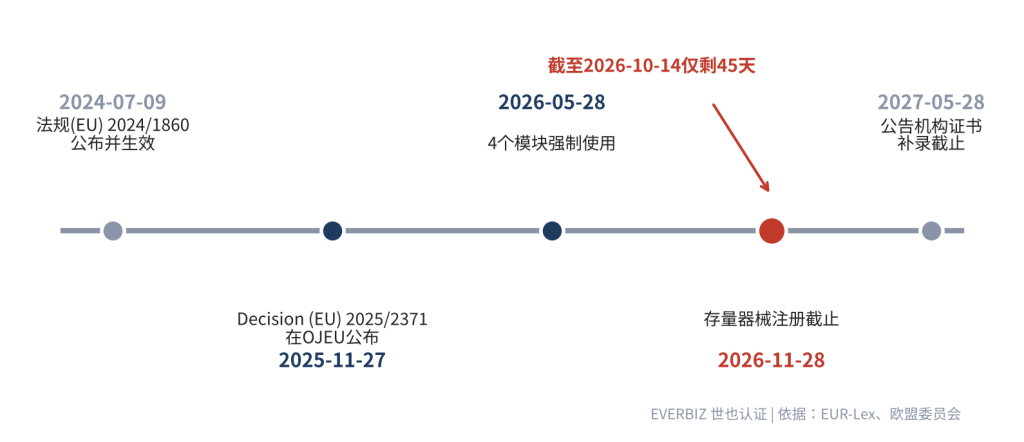
Figure: Key timeline for the first four EUDAMED modules (chart by EVERBIZ)
Note: The legal text requires registration “within 12 months of the publication of the notice”, which some organizations calculate as 27 November; however, the European Commission’s official timeline graphic and Ireland’s competent authority HPRA both state 28 November. To be safe, we recommend companies set completion by 27 November as their internal target.
2. Which Products Must Be Registered by 28 November?
Devices that meet both of the following conditions must be registered in the EUDAMED UDI/device registration module by the deadline:
- The first unit was placed on the EU market before 28 May 2026;
- Units continue to be placed on the market after 28 May.
This covers both “regulation devices” already certified under the MDR/IVDR and “legacy devices” still sold under old MDD/AIMDD/IVDD certificates during the transition period.

— EVERBIZ —
3. Three Situations Where Registration Is Not Needed or Need Not Be Repeated
- No longer placed on the market: devices with no new units placed on the market after 28 May generally do not need to be registered retrospectively; however, if a PSUR, serious incident or field safety corrective action report needs to be submitted later, the device must be registered first.
- Corresponding MDR/IVDR device already registered: if the replacement device for a legacy device, having completed MDR/IVDR conformity assessment, is already registered in EUDAMED, the legacy device does not need to be registered separately.
- New devices first placed on the market after 28 May: there is no transition period – they must be registered before being placed on the market, and the 28 November grace period does not apply.
4. What Is Special About Registering Legacy Devices
Legacy devices are not subject to the MDR/IVDR UDI requirements; EUDAMED generates a dedicated EUDAMED DI and EUDAMED ID for them instead of a Basic UDI-DI and UDI-DI (see MDCG 2019-5). If the same product exists in both a legacy version and an MDR version, the relationship between the two must be clearly mapped so that neither overwrites the other.
In addition, every device registration requires the actor registration to be completed and a Single Registration Number (SRN) obtained. For non-EU manufacturers, the SRN application must be verified with the help of the EU Authorized Representative; if this step is not completed, device registration cannot proceed.
5. What Happens If You Miss the Deadline?
Under the transitional provisions of MDR Article 123 and IVDR Article 113, products that are still unregistered after the deadline but continue to be placed on the market will not comply with the regulations. They face market surveillance measures by Member State competent authorities and may fail compliance checks by customers, distributors and notified bodies. For exporters, the most immediate risk is that EU importers and distributors stop accepting goods because they cannot find the registration information.
— EVERBIZ —
6. EVERBIZ’s Advice: How to Plan the Remaining 45 Days
- Week 1 | Take stock of products: list all models placed on the market before 28 May and still on sale, distinguishing legacy devices from MDR/IVDR devices.
- Week 2 | Check the actors: confirm that the SRNs of the manufacturer and EU Authorized Representative are valid and that contacts and addresses match the certificates.
- Weeks 3–4 | Prepare data: compile device names, classes, certificate numbers, models/variants, labeling information, etc.; if you have many devices, consider XML bulk upload or M2M data exchange.
- Weeks 5–6 | Submit and review: complete submissions and check the status of each record, leaving time to handle rejections and system issues.
Also note: notified bodies must upload MDR/IVDR certificates issued earlier by 28 May 2027, and the upload of the related SSCPs is linked to this; we recommend confirming progress with your notified body at the same time.
Friendly Reminder
Mandatory use of EUDAMED means that device information on the EU market will truly be “searchable online”. EVERBIZ offers one-stop services including EU Authorized Representative, EUDAMED actor registration, registration of legacy and MDR/IVDR devices, and bulk data preparation. Contact us if you would like your product list assessed.
This article is for reference only and does not constitute legal advice; please refer to official EU documents and competent authority interpretations for specific obligations.