
EVERBIZ | Basis: NMPA Notice Guo Yao Jian Xie Guan [2026] No. 14
On 15 September 2026, China’s National Medical Products Administration (NMPA) published on its website the Notice on Issuing the Inspection Guidelines for Good Manufacturing Practice for Medical Devices (Guo Yao Jian Xie Guan [2026] No. 14, dated 14 September). The new Inspection Guidelines for Good Manufacturing Practice for Medical Devices (the “Inspection Guidelines”) take effect on the same day as the new GMP – 1 November 2026.
From that day, both manufacturing license inspections and post-market surveillance inspections will be conducted under the new GMP, with findings and actions determined according to the Inspection Guidelines. With less than 3 weeks to go, this article sets out the key points.
01 First, Distinguish the Dates
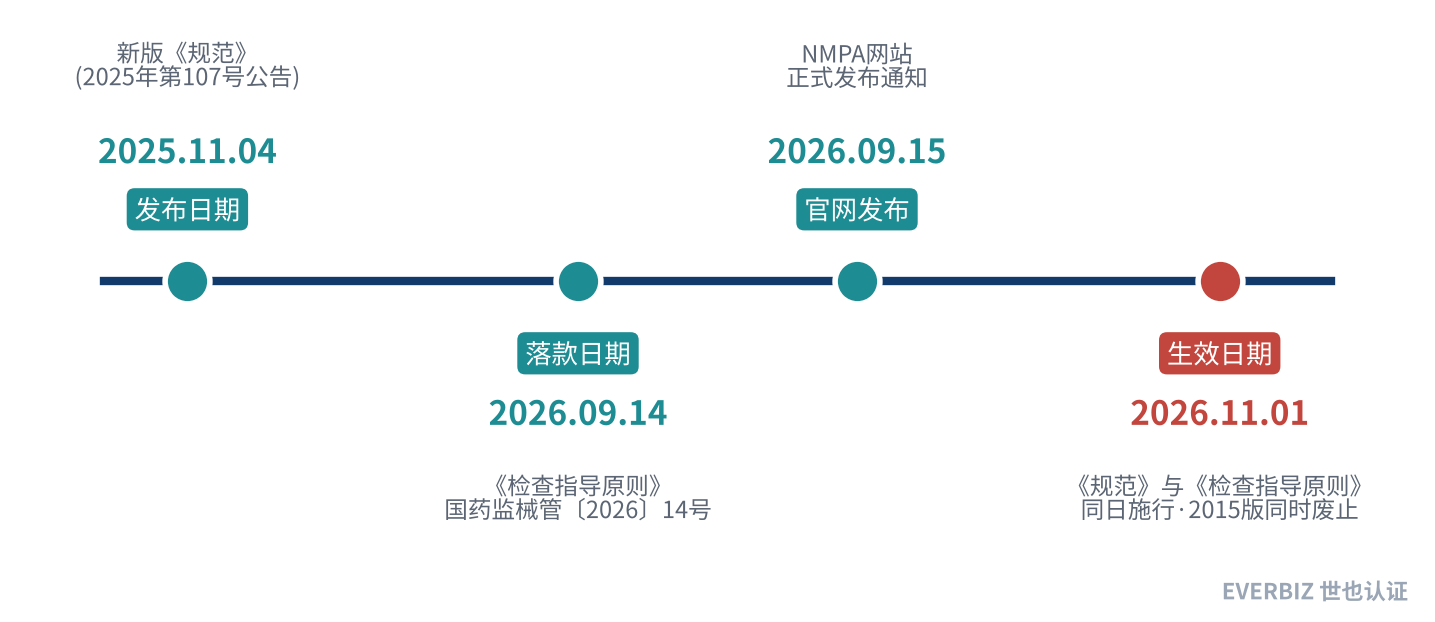
News reports often mix up the “publication date” and “effective date”. EVERBIZ has checked them against the official notice:
| Type of date | Date | Notes |
|---|---|---|
| Publication of the new GMP | 2025.11.04 | NMPA Announcement No. 107 of 2025 published the revised Good Manufacturing Practice for Medical Devices |
| Date signed on the Inspection Guidelines | 2026.09.14 | Date of Notice Guo Yao Jian Xie Guan [2026] No. 14 (14 September) |
| Website publication date | 2026.09.15 | Notice published on the NMPA website |
| Effective date | 2026.11.01 | The new GMP and the Inspection Guidelines take effect on the same day; the 2015 on-site inspection guidelines are repealed at the same time |
| Deadline | No common deadline | The notice sets no separate remediation deadline for companies. Class I filings: authorities should inspect within 3 months of filing. Post-market inspections: provincial authorities draw up risk-based plans to achieve full coverage in phases, with no single national completion deadline |
02 200 Inspection Items in Three Risk Levels
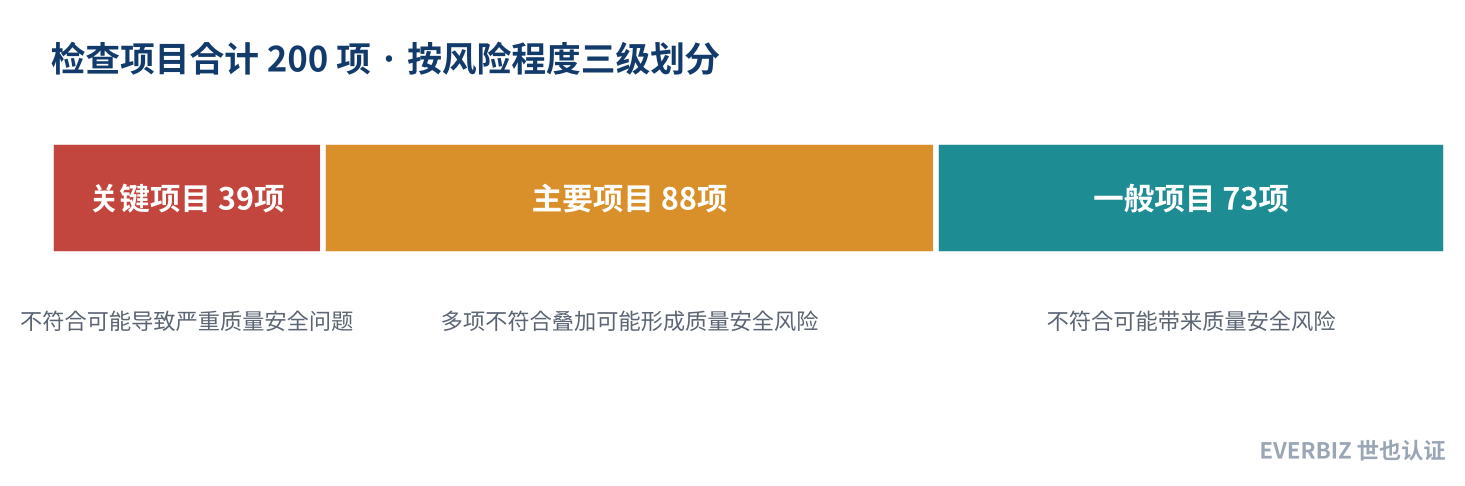
The Inspection Guidelines cover the entire quality management system with 200 inspection items, divided into three levels according to the importance of each clause to the system and the quality and safety risk that non-compliance could create:
- Critical items (39): non-compliance may lead to serious product quality and safety problems;
- Major items (88): several non-compliances combined may create quality and safety risks;
- General items (73): non-compliance may create quality and safety risks.
Two “escalation” rules that are easily overlooked
① Escalation for repeat findings: non-compliances repeated from the previous two inspections may be graded one risk level higher.
② Escalation for systemic risk: where several related non-compliances indicate a systemic risk in the quality system, they may be judged as non-compliance with a critical item in the “Quality Assurance” chapter.
In other words, “old problems that keep recurring” or “small problems appearing in clusters” may be treated directly at a higher level.
03 How Are Inspection Conclusions Determined?
Manufacturing license inspections: conclusions include “passed”, “failed” and “re-inspection after remediation”. Serious situations such as fraud or deception, or 3 or more critical non-compliances, result directly in “failed”.
Post-market surveillance inspections: conclusions include “no non-compliance found”, “self-remediation by the company”, “remediation within a deadline” and “suspension of production for remediation”. The same serious situations result directly in “suspension of production for remediation”.
Partial inspections: post-market surveillance inspections may be full or partial. For partial inspections, minimum chapters to be covered are specified separately for three categories – “registrants/filers manufacturing themselves”, “registrants/filers using contract manufacturing” and “contract manufacturers” – and the same decision rules apply as for full inspections: inspecting less does not mean judging more leniently.
Note: for the specific thresholds for the number of major and general non-compliances, please refer to the original Inspection Guidelines attached to the notice.

04 How Does the Transition Work?
- Before 1 November: manufacturing license inspections still follow the current GMP, while authorities refer to the Inspection Guidelines to assess companies’ implementation of the new GMP and make recommendations for improvement.
- Pending license applications: applications for a manufacturing license, license change or renewal accepted before 1 November but not yet inspected, or inspected but without a decision because remediation is incomplete, will be inspected under the new GMP from 1 November.
- Class I device filings: within 3 months of filing, authorities should inspect the filing documents and GMP implementation; filings made before 1 November but not yet inspected will be inspected under the new GMP from that date.
- Post-market supervision: provincial authorities draw up inspection plans based on product and company risk, achieve full coverage against the new GMP in phases, and require companies to comply on schedule.
- Five special product types: sterile, implantable, IVD reagents, custom-made dentures and standalone software medical devices must comply with both the new GMP and the corresponding current appendices from 1 November; the corresponding inspection guidelines will be revised and published separately.
Repealed at the same time: the former CFDA On-site Inspection Guidelines for Good Manufacturing Practice for Medical Devices (Shi Yao Jian Xie Jian [2015] No. 218).
— EVERBIZ —
05 EVERBIZ’s Advice: What to Do in the Final 3 Weeks
- Gap analysis against the 200 items: focus first on the 39 critical items and prepare objective evidence for each.
- Clean up historical findings: review the last two inspection reports and confirm that remediation is truly closed, to avoid “escalation for repeat findings”.
- Prepare according to your operating model: contract-manufacturing registrants/filers and contract manufacturers are inspected on different chapters, so both parties’ responsibilities and quality agreements should be reviewed together.
- Companies with pending applications: if the license application has not yet been inspected or remediation is incomplete, prepare for on-site inspection under the new GMP.
- Companies with special products: the five product types continue to follow the current appendices; watch for the publication of the dedicated inspection guidelines.
How EVERBIZ can help
New GMP gap analysis · Quality system document upgrades · Mock inspections and remediation close-out coaching
To learn more, leave us a message on our WeChat official account or contact the EVERBIZ consulting team.
This article is original content compiled by EVERBIZ, for reference only; official documents prevail. Please credit the source when republishing.